Wuthering Heights (2011)

wh

Andrea Arnold’s Wuthering Heights, her third feature after Red Road (2006) and Fish Tank (2009), quickly establishes itself as a highly personalised take on the material. Those familiar with Arnold’s earlier films may also perceive common threads that link Wuthering Heights with them. Somehow, as impossible as it is in practice, it’s tempting to try to comprehend Wuthering Heights purely in these terms. It would perhaps be more instructive to view it as an Andrea Arnold film first and an adaptation second.

Faithfulness is a fraught concept when dealing with cinematic adaptations of novels. Since it was published in 1847 (after a reasonable 50-year wait for cinema to be invented), there have been seven film adaptations of Emily Brontë’s Wuthering Heights. Even including the numerous radio and television adaptations, the vast majority cannot be considered ‘faithful’ to the letter of the text, let alone the structure or in the visual realisation of the descriptive elements. Arguably the most celebrated, William Wyler’s 1939 take, diverges from the novel in several ways, including shifting the time period and excising the latter section of the novel completely.

wuthering-heights-poster2

It’s the prerogative of the adaptor to foreground or suppress elements of the original work in service of their own vision. Numerous modern productions of Shakespeare’s plays illustrate this point clearly – if the original has themes and/or content that are universal or at least current, the process can be beneficial for both audiences and the original text. On the other hand, unabridged ‘faithful’ adaptations often suffer from adhering too closely to the particulars of the original while failing to adapt to the requirements of the new medium. Films, it must be noted, are not books and cannot be made, experienced or appreciated in the same way. As Arnold has said of Wuthering Heights, “It’s such a complex book that I just had to pick out the things that had resonance to me, while still honouring the work as a whole.”1

The film places a crucial emphasis on the formative early lives of the characters, so that half of the running time is taken up with only one third of the novel. To distil the essence of a 30-year, generation-spanning story, Arnold therefore has focussed on the elemental aspects of the story, the passions and frustrations from which Brontë’s saga emerges. The film is so visually-driven that the character’s more articulate moments, when the dialogue is closest to that of the novel, are somehow the least convincing. Arnold’s Heathcliff is far less verbose than in earlier depictions, his pride and cunning subdued in favour of a more primal drive. When Cathy returns from the Lintons, dressed in the manner of a lady, Heathcliff reacts badly (and mistakenly) to Cathy’s greeting. In the novel, he is indignant, exclaiming, “I shall not stand to be laughed at. I shall not bear it!” This line in the film becomes, “Why are you laughing at me?” and the delivery implies less wounded pride and more uncomprehending hurt, quickly tempered with reflexive aggression.
wh3

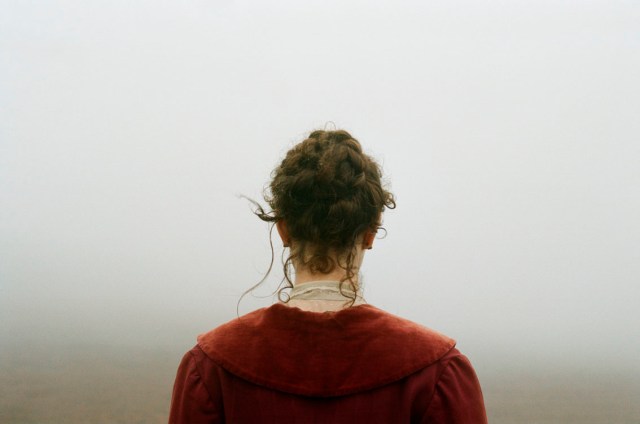
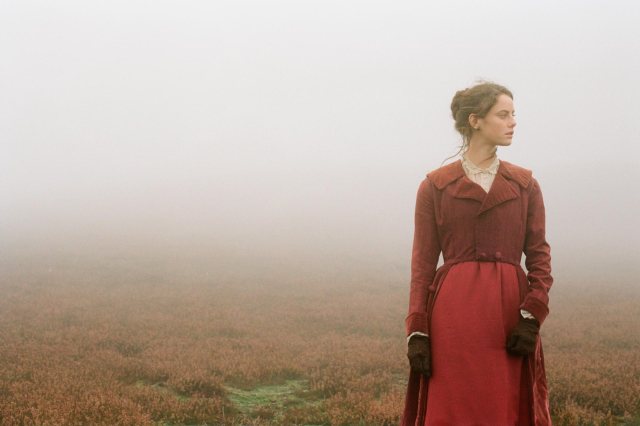
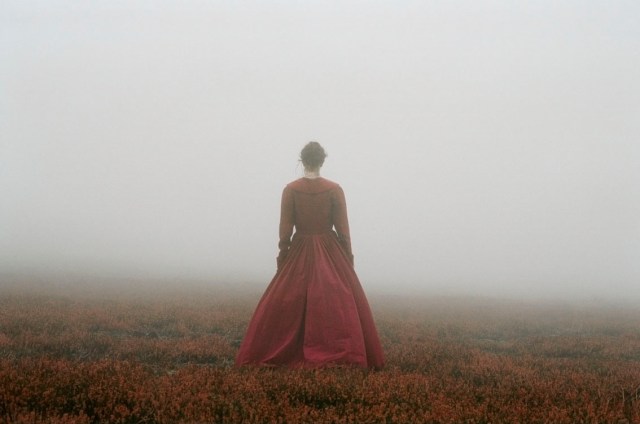
The film’s visual language is exponentially richer, with the novel’s second generation story and its ‘cruelty begets cruelty’ theme subtly coded in the moment Hindley’s son Hareton mimics Heathcliff’s mistreatment of a dog. In the latter half of the film, the frequent flashbacks to the early lives of the protagonists indicate how fatally the die is cast for both Heathcliff and Cathy far better than any dialogue – rather than fond reminiscences, they are a reminder that the characters are bound by and to a past they can never return to. Arnold’s mise-en-scene also transforms the stately home (however imposing) familiar from previous adaptations into a dark and claustrophobic farm holding. Here, Arnold’s approach once more strains against the material, as the run-down Wuthering Heights seems at odds with the means and standing that the story dictates the Earnshaw family should have.

Ahead of its release, much has been made of Arnold’s digressions from the source material. Commentators have noted liberties taken with the language (e.g. the racial epithets spat at Heathcliff and his own impassioned dismissal of the Lintons), the depictions of animal cruelty and, perhaps most of all, the casting of black actors (Solomon Glave and James Howson) in the role of Heathcliff. Heathcliff’s racial origin is never explicitly defined in the novel, although with close analysis, the best guess is that he is of Romany descent. He is physically described in such a variety of ways that truly, only his otherness is clearly defined. Evidently, it is this element that informed Arnold’s approach. As she has said, “In the end, I decided that what I wanted to honour was his difference.”2 The director has also speculated that, were she to approach the material again, she might cast a woman in the role.
wh2

Therefore, while Arnold’s social realist approach cannot fail but re-emphasise the novel’s themes of racial intolerance and class division, her unremitting focus is on Heathcliff himself and the inchoate rage he shares with Fish Tank’s Mia (Katie Jarvis). The film opens, as does Fish Tank, with its protagonist engaged in his habitual solitude. While Mia dances in the empty flat she uses to practice her routine, the grown Heathcliff haunts Cathy’s old room, throwing himself at the walls in despair.

Both characters’ emotional volatility is matched only by their inability to articulate themselves. Just as Fish Tank privileged Mia’s point of view, following her as she roamed alone through claustrophobic corridors, rooms and busy but desolate estates, Wuthering Heights focuses on the experience of Heathcliff. Throughout the film, the camera follows Heathcliff, often peering with him at scenes he is excluded from. As in Red Road, the central protagonist struggles against an enforced isolation that they are also complicit in.

Brontë concludes her story with Heathcliff’s death and the notion that he at least is now ‘with’ Cathy. Arnold rejects even such an illusory resolution. “In my version, I have to leave him suspended. It’s unresolved – you almost feel that he’s still out there, wandering the moors.”3 A tiny, post-credits clip reprises Cathy’s famous line, “I am Heathcliff”, a final directorial flourish inviting the perhaps over-analytical viewer to take a closer look at Arnold’s empathy with her protagonist.

Sean Welsh, November 2011
This article was originally commissioned as a programme note by GFT.


Footnotes

1. Andrea Arnold, Guardian interview, 31/10/2011.
2. Ibid.
3. Ibid.

Posted in Cinema, Film, GFT, Glasgow, Movies, Programme Note | Tagged , , , , , , , , , , , , , , , , , | Leave a comment

The Tree of Life (2011)

tree-of-life-movie-stills-hi-res-jessica-chastain-brad-pitt

“The film is an empty Christmas tree: you can hang all your dumb metaphors on it.”1
Pauline Kael on Days of Heaven

Deciphering the intentions of Terrence Malick has engaged critics and audiences alike since the time of his first film, Badlands, in 1973. Interested parties have been encouraged and thwarted in equal measure, it seems, by Malick’s legendary absence from public life and, more particularly, his refusal to contribute to any kind of debate around his work. Though The Tree Of Life (2011), only his fifth film, recently won the Palme D’Or, it has divided audiences. On one extreme, those who claim that “Malick is a director who is not only more intelligent than his critics, but better-educated too”2 and, on the other, those that insist “Terrence Malick is one of the overrated directors of all time.”3 However, the consensus is that the film is typically ‘Malickian’ in style and continues the director’s preoccupation with certain recurring themes.

As Nick James of Sight & Sound has pointed out, “If one consistent theme bridges all of Malick’s cinema, it’s that every film re-enacts the fall of mankind from some kind of Garden of Eden.”4 In the context of The Tree Of Life – a title with simultaneous biblical and Darwinian connotations – the nostalgic presentation of a 1950s family life preceding a Fall certainly lends itself to such a ‘reading’. The production notes refer to the climactic reunion scene taking place in a “numinous space”,5 analogous perhaps with a commonsense understanding of heaven. However, certain contradictory elements suggest drawing a purely religious meaning would be reductive.

treeoflifeposter

Those tempted to make a religious ‘reading’ – inspired certainly by the opening quotation from the Book of Job – will perhaps be wrong-footed by the long sequences purporting to show the dawn of the universe and the natural evolution of life on our planet. The apparent contradiction is perhaps not as instructive as it seems. According to Pitt, “[Malick] sees God in science and science in God.”6 Additionally, Q, the aborted Malick project in which The Tree of Life seems to have its roots, reportedly envisioned a similar sequence, but preceded with images of “a sleeping god, underwater, dreaming of the origins of the universe.”7

The sequences featured in The Tree Of Life include the impressionistic, experimental work of Douglas Trumbull. The legendary special effects supervisor (returning to movies after a suitably Malickian self-imposed exile of almost 30 years) contributed ‘old school’ effects of the oil and water variety – not, on the surface, the most scientific of representations. But, again, purely religious ‘readings’ are stymied by Malick’s reported fastidiousness in scientific research. As Dan Glass, senior visual effects supervisor on The Tree Of Life, explains, “It was very important to him that in the midst of trying to make beautiful, emotional imagery that it also be representative of the latest scientific theories. As we arrived at ideas and shots, these would be sent to scientists for their input.”8

tree-of-life-movie-stills-hi-res-jessica-chastain-brad-pitt-8

For further insight into the director’s intentions, those disinclined to rely solely on the films themselves are forced to look to the biographical details we have, the extremely rare interviews he has given, the scripts for his films (the descriptions in which are often as lyrical as his films) and the testimony of those who have worked with him. As revelatory as these lines of enquiry can sometimes seem, the very fact of the director’s refusal to speak of his work and to retire almost entirely from public life is perhaps instructive. Nevertheless, it has been generally suggested that The Tree of Life is Malick’s most autobiographical film to date and, again, the temptation is to ‘read’ it as such.

terrence_malick_filming

The potentially pertinent biographical facts are as follows. Malick grew up in Texas and Oklahoma in the 1950s, the eldest of three brothers, the youngest of whom apparently killed himself in the late 1960s. Malick reportedly was “devoted to this mother… but he had terrible fights with his father.”9 He went on to study philosophy at Harvard and Oxford, later lecturing briefly at MIT, although he claims not have been good at it, explaining, “I didn’t have the edge one should have on the students, so I decided to do something else.”10 During this time, he studied the work of philosopher Martin Heidegger, among others, a fact that for some helps explain his approach to directing.

For Hwanhee Lee, “Malick’s understanding of cinema seems to be influenced by Heidegger’s contention that it is a cardinal symptom of modernity … to apprehend reality as something to be differentiated from how it appears to a subjective consciousness and that reality is understood at the most fundamental level as something to be mastered.”11 Malick, therefore, is “wholly uninterested in envisioning his films as epistemological (or moral, or sociological, or what have you) inquiries for the audience and the characters, instead preferring to envision them as a presentation of the world, in all its variety, as something to be faced with reverence.”12 Simon Critchley cautions that “a consideration of Malick’s art demands that we take seriously the idea that film is less an illustration of philosophical ideas and theories … and more a form of philosophising, of reflection, reasoning, and argument.”13

An essential problem in ascribing any definitive philosophy to The Tree of Life, or any of Malick’s films, is that cinema in its purest form is experiential – it can be shared or intensely personal but is generally incredibly subjective and cannot be read as a book can. On one of those rare occasions Malick was moved to discuss generally the power of (his) cinema, he offered, “For an hour, or for two days, or longer, these films can enable small changes of heart, changes that mean the same thing: to live better and to love more. And even an old movie in poor and beaten condition and can give us that. What else is there to ask for?”14

Sean Welsh, July 2011
This article was originally commissioned as a programme note by GFT.


Footnotes

1. Pauline Kael, 5001 Nights at the Movies (New York: Henry Holt, 1991), p177
2. Michael Newton, ‘Terrence Malick: Act of Creation
3. Uwe Boll, as quoted in ‘Uwe Boll: “The Tree of Life Is A Piece Of Sh*t”
4. Nick James, ‘Daze of Heaven’, Sight & Sound, July 2011, p21
5. The Tree of Life production notes, p13
6. Brad Pitt, as quoted in Steve Rose, ‘Brad Pitt Talks About Terrence Malick and The Tree of Life
7. Paul Ryan, as quoted in Peter Biskind, ‘The Runaway Genius
8. Dan Glass, The Tree of Life production notes, p10
9. Peter Biskind, ‘The Runaway Genius’, ibid
10. Terrence Malick, as quoted in Beverly Walker, ‘Malick on Badlands’, Sight & Sound, Spring 1975
11. Hwanhee Lee, ‘Terrence Malick
12. Ibid.
13. Simon Critchley, ‘Calm: On Terrence Malick’s The Thin Red Line
14. Terrence Malick, as quoted by Yvonne Baby (translated by Hugues Fournier and Paul Maher Jr), ‘Terrence Malick Interview: May 17, 1979

Posted in Cinema, Film, GFT, Glasgow, Movies, Programme Note | Tagged , , , , , , , , , , , , , | Leave a comment

Senna (2010)

Film title: Senna

“Everything that happens is real, and I didn’t shoot a frame of it. I didn’t need to. My team and I used the actual footage to create a three-act story of the life of Ayrton Senna.”1
Asif Kapadia

“All aspects of documentary filmmaking involve choice and are therefore manipulative.”2
Frederick Wiseman

Senna (Dir. Asif Kapadia, 2010) is an unusual film. It represents the first foray into documentary film for the writer, director, producer and even the production company (Working Title). Disregarding his inexperience in the documentary form, Asif Kapadia is still not the most obvious choice to direct the first major film to deal with the life of Formula One legend Ayrton Senna. The resume of the British director, originally from Hackney, chiefly contains epic but understated human dramas in remote locations (he presented his last, Far North, at the Glasgow Film Festival in 2008) alongside one ill-fated foray into the Hollywood thriller genre with The Return (2006).

Kapadia has said, “For me, film is a very visual medium. I’m not the sort of person who will make a film that is really dialogue heavy”3. For Senna, the director’s preference for visual storytelling has evolved into a rejection of talking heads or objective voiceover as part of the fabric of his film and a reliance instead upon period footage and audio-only interviews with first-hand observers of and participants in the story.

senna2

Although any story dealing with spectacular endeavour but ending in tragedy is ripe for dramatic depiction, several moments in Senna are almost preternaturally suited to the scheme of the monomyth, Joseph Campbell’s famous “hero’s journey” template for world myth. This seems even more remarkable, given Kapadia’s decision to reject the standard talking heads and voiceover approach, which would have allowed a more authorial slant. Dealing with only extant footage and focussing wherever possible on the subject’s own narration, the heroic account of Senna’s journey appears self evidently veracious.

It’s less remarkable, perhaps, when the filmmakers’ explanation of their deliberate approach is taken into account. Kapadia and Manish Pandey, the writer, make no bones about their intention to structure the film in this way and certainly do not shy away from the mythical subtext. Pandey has said, “Senna’s story is, for me, the story of man – of his quest for perfection in this worldly life and of his journey home to God.”4 The writer has elucidated, “I even had in my mind what the three acts would be – his ascent to the World Championship, his struggle, which only begins when he becomes World Champion, and then his death, which is the whole third act.”5 The result is a film that has been described as “hagiographic”6 and “panegyric”,7 but most often has simply been praised for its thrilling, Hollywood-style presentation of real world events.

senna3

Often consciously employed in fiction (most famously by George Lucas for his Star Wars saga), the monomythical structure is not unknown in documentary film. Academy-Award-winning documentary maker Davis Guggenheim made overt use of it in The First Year (TV, 2001) and An Inconvenient Truth (2006), where imposing Joseph Campbell’s structure on Al Gore’s life ostensibly made the science involved more compelling for prospective audiences. Senna is equally as deliberate in its presentation, even though the subject matter is far more obviously suitable.

Campbell’s 1949 book, The Hero With A Thousand Faces, delineates several stages of the mythical hero’s journey, not all of which have to be present in every story, and not necessarily in the same order. Divided in three sections that correspond with Pandey’s description of the acts of his script (Departure, Initiation and Return), many of the individual stages can be identified in the final film’s construction. Thus Senna heeds The Call To Adventure when he enters into the world of racing, traverses The Road Of Trials with its “multitude of preliminary victories”,8 finds Atonement With The Father, wherein he “transcends life with its peculiar blind spot and for a moment rises to a glimpse of the source,”9 and achieves Apotheosis (“He opened the Bible and read a passage that said God would give him the greatest gift of all, that of God himself.”10 Finally, upon his death, Senna becomes The Master Of Two Worlds, physically departed but alive in legend.

senna4

Imposing this mythic structure on the 15,000 hours of footage reportedly available, the filmmakers inevitably excised elements that perhaps did not fit the overall arc. It is also important to note that Senna is a film that would not have been possible without the approval of Senna’s family and Eccleston, two parties that clearly lack total objectivity. Further, by limiting themselves to the available footage and, as a rule, focussing on pre-existing interviews with Senna himself, the filmmakers would not be able to draw in much relevant but peripheral information. For example, Jean-Marie Balestre, the clear ‘villain’ of the piece – although also analogous with Campbell’s mythical father figure – had a questionable background in the French SS. Aside from the villainous connotations of such a history, it has been suggested his consequent conspicuous patriotism may have clouded his judgement with regards to Senna’s rival Prost.11 Neither is any mention made of Senna’s brief marriage, or his three-year relationship with Adriane Yamin, who was 15 when the courtship began.

On the other hand, while footage apparently exists of Senna standing at the corner where he met his death, one month earlier, saying “Somebody is going to die at this corner this year”, Kapadia rejected its use,12 perhaps aware that the subtle but profound fatalism his film evokes would be undermined by such an overt statement. However, a 90-minute rendition of any human life is inevitably reductive and, as John Grierson famously claimed, “The only reality which counts in the end is the interpretation which is profound.”13 Senna’s own sense of fate, of God’s will, is what drove him and what ultimately drives Senna.

Sean Welsh, June 2011
This article was originally commissioned as a programme note by GFT.


Footnotes

1. Asif Kapadia: ‘Why I Made Senna
2. As quoted by Frank Spotnitz, ‘Dialogue on Film: Frederick Wiseman’, American Film, May 1991
3. Asif Kapadia, Case Study: Asif Kapadia
4. Manish Pandey, ‘The Journey To Senna
5. Manish Pandey, quoted in ‘Senna: The Making Of A Screen Idol’, Motorsport Magazine, July 2011, p53
6. Matt Bochenski, Senna review, Little White Lies, May/June 2011, p63
7. Dan Jolin, Senna review, Empire, July 2011,p44
8. Joseph Campbell, The Hero With A Thousand Faces (Princeton: Princeton University Press, 2004), p100
9. Ibid, p135
10. Viviane Senna in Senna (Dir. Asif Kapadia, 2010)
11. David Wakefield, ‘Obituary : Jean-Marie Balestre
12. Jolin, p44
13. John Grierson, Grierson on Documentary ed. Forsyth Hardy (Los Angeles: University of California Press, 1966) p145

Posted in Cinema, Film, GFT, Glasgow, Movies, Programme Note | Tagged , , , , , , , , , , , , , , , | Leave a comment

Chi-Raq Programme Note for GFT

This slideshow requires JavaScript.

‘In da year 411 BC, before baby Jesus, y’all,
Da Greek Aristophanes penned a play satirizin’ his day.
And, in the style of his time, ‘Stophanes made dat shit rhyme…’

Chi-Raq (Spike Lee, 2015) is screening at GFT from Friday 2nd December to Thursday 8th December. My accompanying programme note will be available at screenings and there’s an online version at GFT’s blog here.

chi-raq-dolemedes

“When you are honest about American life, subtle doesn’t work for us, we’re too stupid for subtle… Sophisticated people think they get it and say, ‘Oh, this is great,’ but that is such a small percentage of the people out there that we want to reach with the film. The sophisticated people aren’t the ones we want to reach with the film. I mean, the sophisticated people aren’t the victims of what’s going on.”

Kevin Willmott, screenwriter of Chi-Raq (Indiewire).

https://vimeo.com/144523728

Posted in Cinema, Film, GFT, Glasgow, Movies, Programme Note | Tagged , , , , , , , , , , , , , | Leave a comment

Hunt For The Wilderpeople Programme Note for GFT

hunt

Hunt For The Wilderpeople (Taika Waititi, 2016) is screening at GFT from Friday 16th September to Thursday 22th September. My accompanying programme note will be available at screenings and there’s an online version at GFT’s blog here. GFT archives all its programme notes online here.

Posted in Film, GFT, Glasgow, Movies, Preview, Programme Note | Tagged , , , , , , , , , , , , , , , , , , , | Leave a comment