Larry Cohen on The Stuff

The StuffThis week, Arrow Video released Larry Cohen’s The Stuff on Blu Ray. To mark the occasion, here’s an excerpt from the zine Physical Impossibility #1: The Films of Larry Cohen, featuring my exclusive interview with the man himself.

“The big studio films are like concert orchestras, philharmonics, and my movies are like jazz combos.” Larry Cohen

Upstate New Jersey, 1985. A refinery worker finds an odd white substance bubbling out of the ground. Inexplicably, he paws some into his mouth…and finds it delicious. Packaged and sold as a dessert, The Stuff is soon taking the nation by storm and the fat cats of Big Confectionary don’t like the new competition one bit. They hire oddball industrial saboteur David ‘Mo’ Rutherford (Michael Moriarty) to uncover The Stuff’s secret formula and protect their profits. Meanwhile, young Jason (Scott Bloom) is repulsed by his family’s addiction to the Stuff. After all, he’s seen it moving.

After Q: The Winged Serpent (1982), Larry Cohen directed two films back-to-back, Special Effects (1984) and Perfect Strangers (1984). Cohen, aware of the second life DVD has afforded some of his lesser-known works says, “I recommend anybody who’s interested to see those pictures.” Anyone could be forgiven, however, for first skipping on to arguably his finest film and a genuine absurdist masterpiece, The Stuff.

A satire on commercialism, The Stuff is also an unpredictable, free-wheeling fever dream of a movie which takes so many left turns it’s dizzying. “I don’t follow any rules and regulations about placement of scenes or arcs or anything else,” Cohen offers. “All the stuff that they teach you in writing class and all the stuff in screenwriting books, I don’t pay any attention to any of that. The people teaching writing classes have never sold a script.”

The kind of sparkling, strange moments of performance (Michael Moriarty acts less like he’s ‘in on the joke’ than he’s wondered with casual agency into someone else’s dream), staging and sheer filmmaking audacity that make curate’s eggs of many a B-movie are pretty much the substance of the entire film. Cohen here was firing on all cylinders doing what he does best – giving free reign to his imagination with an intriguing premise then supporting and encouraging his star performer to improvise freely, and all the while wringing his budget for all its worth. It’s jazz filmmaking, as Cohen explains. “We improvise as we go along, we change based on what happens to us while we’re making the movie, we incorporate things into the movie that happen to us.”

“At the beginning of The Stuff, we got to our location to shoot and a terrible snowstorm came. It was unseasonable but this huge blizzard came and everybody said, ‘Oh, now you have to go home,’ and I said, ‘Oh, no, we’ll shoot the scene in this snowstorm and I’ll write the snowstorm into it.’ And so that’s what I did. And it made a beautiful scene, beautiful production value. Of course, all the lights weren’t rigged for a snowstorm so they were exploding all over the place. But fortunately, nobody got electrocuted and we got the scene.”

The Stuff is also one of those strange films you stumble across 25 years after the fact and marvel at the audacity of what you’re watching. Pre-CGI, the low-budget practical effects are surprisingly effective – ambitious, charming and tactile – everything that modern horror or sci-fi generally isn’t. When it works best (the motel room sequence when Mo is attacked by his Stuff-filled pillow – seriously – which then engulfs the entire room, scaling the walls, before being killed with fire), the impact of the technical wizardry is enhanced by the growing sense that filming it couldn’t possibly have been safe.

“Oh, the flaming room?” Cohen recalls, “We did the same thing there that Fred Astaire did in Royal Wedding, where he danced on the ceiling.” The set was built in a room that could be rotated from the outside, with the camera locked in place inside. Therefore, when the set was spun, the camera turned with the room, capturing the seemingly gravity-defying effect of the Stuff emerging from under the bed, climbing the walls and carrying Moriarty with it. “And we wanted it to catch fire too, so that’s something Fred Astaire didn’t have to worry about, was fire.”

 “The guys that built it, they had guys on both sides of it, clinging to the outside of the room and they would jump up and down and jump up and down and jump up and try to keep hold of the goddamn thing because it was turned on its side and then the force of their weight and the gravity of it turned the thing upside down. There were people clinging to the outside of it and on the inside, it was on fire! Nobody got hurt, thank god, and we got the scene, but it was quite a show to watch it in progress.”

Physical Impossibility #1: The Films of Larry Cohen is sold out at the source, although copies may be available from our international stockists (check details here).

The Stuff Blu Ray, which I can heartily recommend, is in shops now, or you can buy direct from Arrow here.

The Stuff

The Stuff illustration for Physical Impossibility by Ryan Bharaj

Posted in Interview, Larry Cohen, Movies, Zine | Tagged , , , , , | 1 Comment

#GFF14

IMG_4335

Hello! Just a quick update with the full run-down of my contributions to the Glasgow Film Festival website, in my fourth year as official GFF blogger. First, the picks of the programme which, while a little out-of-date by now, are still incredibly readable and fascinating in themselves:

Five Picks From the Festival Programme

Picks From the Festival Programme: CineChile

Picks From the Festival Programme: Stranger Than Fiction

Then there are the short questionnaires I gave to some key GFF staff members, asking about how they came to GFF, their favourite GFF memories and what the future might hold:

Five Questions for…Sharon Grogans (GFF Special Projects Manager)

Five Questions for…Corinne Orton (Festival Producer)

Five Questions for…Sean Greenhorn (GFF Programme Coordinator)

Then interviews with two directors whose work featured in the Crossing The Line strand, “where visual art and cinema combine,” programmed by the wonderful Carolyn Mills:

Interview: Museum of Loneliness with Chris Petit

Interview: Ed Atkins (Man of Steel)

And finally, the main feature – eight diaries covering 11 days of film watching, event attending, frantic writing and a reasonable amount of standing in queues. There are reviews, recounting of Q&As and blow-by-blows of special events and performances:

Festival Diary #1

Festival Diary #2

Festival Diary #3

Festival Diary #4

Festival Diary #5

Festival Diary #6

Festival Diary #7

Festival Diary #8

During the festival, I launched the second issue of my movie zine, Physical Impossibility, at Saramago. (I also managed to stuff one into the hands of Mark Cousins at the festival closing party.) Read more about the zine here, and find out how to pick up a copy here. These photos of the launch were taken quite early on in the evening:

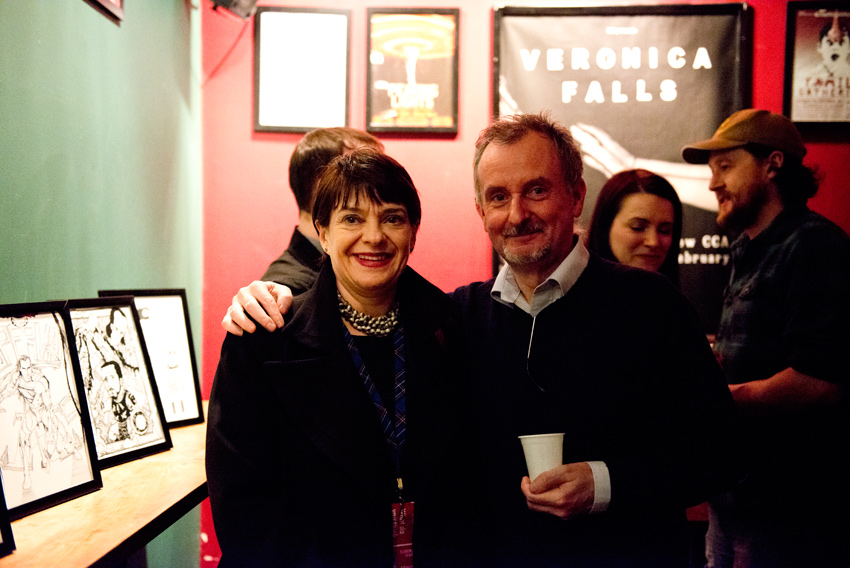
seanzine2launch_0045

Allison Gardner (Glasgow Film Festival Co-Director) and John McShane (AKA Books & Comics and Fat Man Press co-founder) at the Physical Impossibility #2 launch. Also myself, zine contributor Laura Aitchison and man/myth Stewart Hunter in the background.

Thanks again to GFF for having me, to all the venue staff and volunteers, the Sunday Herald for having me on their Everyone’s A Critic panel and to Tommy McCormick for being a pacemaker par excellence and for generally keeping GFT in business.

p.s. I’d also like to recommend you check out the contributions of my fellow GFF blogger, the extraordinary Chris Buckle:

Five Picks From The Festival Programme: Chris Buckle

Chris Buckle’s Festival Diary #1

Chris Buckle’s Festival Diary #2

Chris Buckle’s Festival Diary #3

Posted in GFF 2014, Glasgow, Interview, Movies, Reviews | Tagged , , , , , , , , | Leave a comment

Popcorn Droppers

Cover

Illustration by Ciara Dunne

I enjoyed writing it because I knew on every level that it was never going to get made… It’s what’s called a popcorn dropper.”

Nick Cave on his script for Gladiator 2

There’s a Hollywood adage that “no-one sets out to make a bad movie,” and while Uwe Boll has done his best to turn the balance of probability in favour of all other filmmakers, all-too-often that’s the end result. For every truly great film there are approximately 15 million that don’t quite measure up. And for every 15 million that don’t measure up, there are roughly 60 bazillion scripts that don’t make it past the first draft. In a seemingly endless sea of sequels, prequels, reboots and reimaginings, we should probably be glad some never make it to second draft, let alone cinemas. Others, though, seem to be tragic missed opportunities, just too weird to live, and in their unrealised states they’re the Schrödinger’s cats of cinema.

The stories of these projects, and in some cases the wide availability of their scripts, generate a level of interest in direct proportion to their unlikeliness. Sometimes too weird to live is simply too good to be true, as with the story of Orson Welles’ Batman, which teased an abandoned script and pre-production photographs but turned out to be just a persuasive hoax by Kick Ass creator Mark Millar. That’s not to say there’s any shortage of vaguely unbelievable but true stories out there. In order of likelihood, we could have had David Lynch’s Revenge of the Jedi (he was offered, didn’t want to do it), Quentin Tarantino’s Casino Royale (he offered, they didn’t want him to do it) or Terry Gilliam’s Watchmen (he thought it unfilmable, funding fell through). Add to that list Rob Zombie’s The Crow 2037, Oliver Stone’s Planet of the Apes, James Cameron’s Spider-Man, Darren Aronofsky’s Batman: Year One, George Romero’s Resident Evil and, perhaps most heartbreakingly, Alejandro Jodorowsky’s Dune, all projects for which abandoned scripts actually exist.

For every well-known writer-director, in fact, there’s an ever-growing list of unrealised projects, cherished by fandom. David Lynch, for example, has Ronnie Rocket and One Saliva Bubble, Terry Gilliam has The Detective Defective, Tarantino has Kill Bill Vol 3Killer Crow and most recently The Hateful Eight, The Coen Brothers have To The White Sea and George Romero has Diamond Dead. Some of those still have a chance of being made – Terry Gilliam’s The Man Who Killed Don Quixote famously refuses to die and his Good Omens adaptation may find a home on television, while production of his latest feature, The Zero Theorem (2013) had been twice stalled and twice recast before cameras rolled. Spielberg’s plundering of Kubrick’s pile of unmade scripts has already given us AI Artificial Intelligence (Steven Spielberg, 2001) and might soon see his infamous Napoleon project realised as a television series. Tim Burton’s Beetlejuice 2: Beetlejuice Goes Halloween is apparently still a going concern, and might even not be terrible. Unlike, for example, Ridley Scott’s Alien prequel, Prometheus (2012) – which itself reportedly put paid to Guillermo del Toro’s At The Mountains of Madness project – and Scott’s threatened Blade Runner sequel, which presumably will be awful. All of which teaches us that hit film plus name writer-director adds up to “never say never”. The future remains relatively bleak for most, though.

For every successful film, there’s a mooted sequel, if not a franchise. Proposed sequels are, for various reasons, particularly prone to obsolescence. They fail to manifest, variously, because the film(s) preceding them underperform and they’re subsequently cancelled, agreement can’t be reached on a fitting follow-up, the creative team and/or the money men go cold on the idea or because key cast members age out of their roles and/or simply die waiting for the green light. Some scripts are replaced by all-new drafts that make them obsolete (sometimes even cannibalising elements of the original script) or they simply miss their shot (a draft of Forrest Gump 2: Gump and Co, for example, was apparently delivered on September 10th, 2001 and quickly deemed anachronistic, a fate which also befell Francis Ford Coppola’s Megalopolis project). For all those reasons, say hello and goodbye to Casablanca 2: BrazzavilleET The Extra Terrestrial 2: Nocturnal FearsRoger Rabbit 2: The Toon Platoon, William Gibson’s Alien 3 (the one with no Ripley), Eric Red’s Lost Boys 2Se7en 2: Ei8ht, Eric Red’s Alien 3 (the one in a bio-dome), Tom Mankiewicz’s pre-Burton Batman, David Twohy’s Alien 3 (the one on a prison planet, but no Ripley), Joel Schumacher’s Batman Triumphant and Batman: DarKnight, Quentin Tarantino’s Double V Vega, Vincent Ward’s Alien 3 (the one with Ripley, but on a wooden planet).

There are also some projects that have begun to be considered simply unfilmable, from originals like Lem Dobb’s legendary 1979 script, Edward Ford, to literary adaptations like James Joyce’s Ulysses (Sergei Eisenstein fancied a crack at one point) or John Kennedy Toole’s A Confederacy of Dunces (Stephen Soderbergh’s script for Will Ferrell got as far as a staged read-through). Zeppelin vs Pterodactyls was the original Mega Shark vs Giant Octopus; these days Hammer Films would probably have the means to take it beyond a tentative promotional poster. In the midst of all these, you find films so strange, so misguided or just so fundamentally unlikely that you wish they had been made, even though, to paraphrase Nick Cave, they simply had no fucking chance. Those, my friends, are the Popcorn Droppers.

This article is taken from Physical Impossibility #2: Popcorn Droppers, which is on sale now from selected stockists. The zine features original writing by Sean WelshRyan BalmerMatt Carman, Craig McClure, Paul McGarvey and Harriet Warman with original illustrations from Laura AitchisonCiara DunneStephen KellyJon Paul Milne, Jack Somerville, ID Stewart and Kseniya Yarosh.

You can also buy a copy directly, here. It costs £4 + 90p postage within the UK (1st class Royal Mail). NB If you are an international customer, please contact sean.m.welsh@gmail.com prior to ordering, and I’ll get back to you with a postage quote.

btn_buynow_SM

image-1

Posted in Glasgow, Movies, Popcorn Droppers, Zine | Tagged , , , , , , | 2 Comments

Glasgow Film Festival 2014

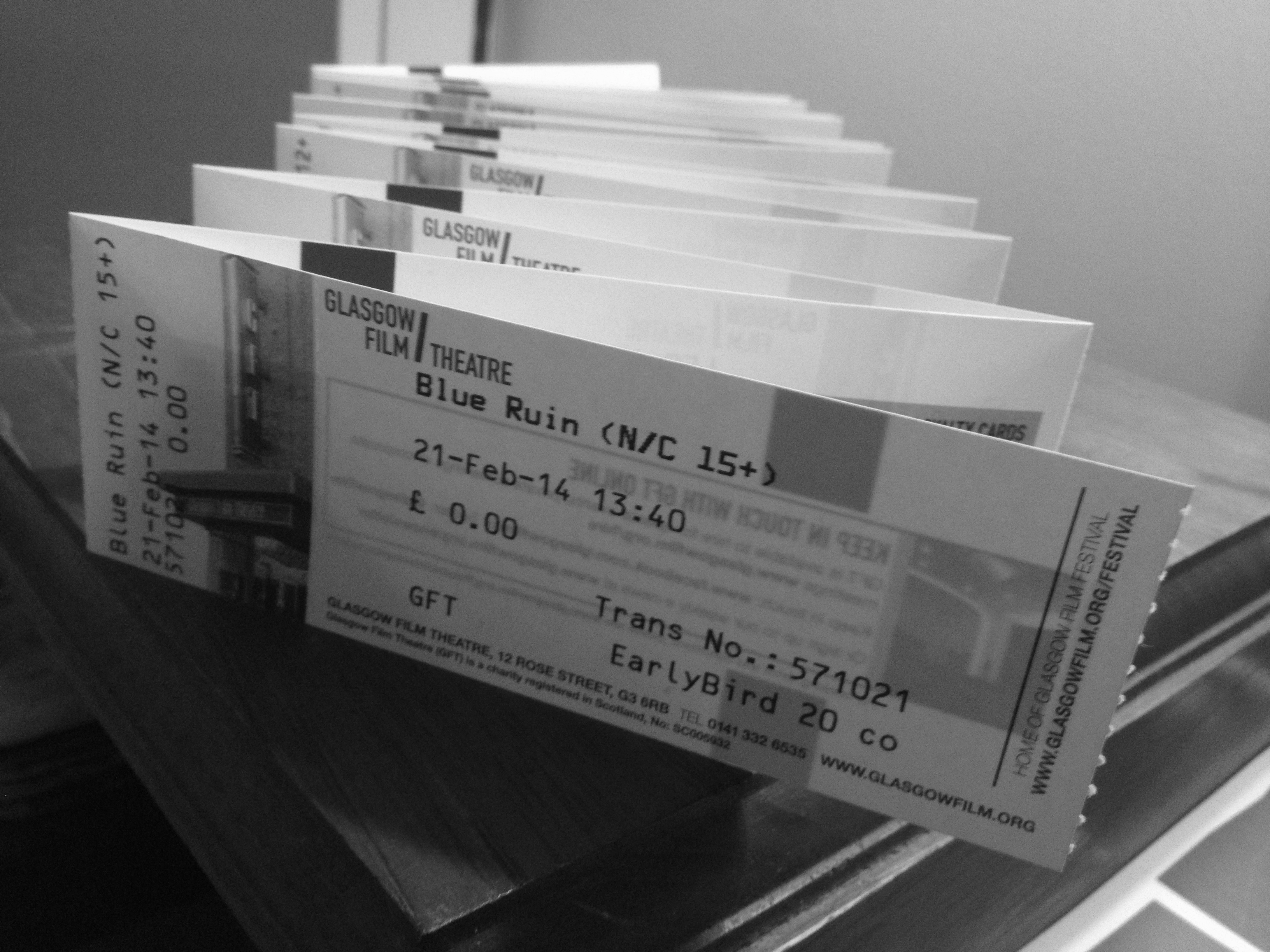
photo

I’ve just begun my fourth year as official blogger for Glasgow Film Festival. I’ve got myself a 20-ticket Early Bird Pass, a ticket for Goblin and an armful of screeners and press tickets. I’ll be contributing picks from the programme, interviews and daily diaries to the GFF Blog, here. Check the byline, because there will also be contributions from the CineSkinny, festival staff and my fellow blogger Chris Buckle. Catch up on what I’ve posted so far:

Five Picks From the Festival Programme

Five Questions for…Sharon Grogans (GFF Special Projects Manager)

Five Questions for…Corinne Orton (Festival Producer)

Five Questions for…Sean Greenhorn (GFF Programme Coordinator)

Interview: Museum of Loneliness with Chris Petit

Interview: Ed Atkins (Man of Steel)

Festival Diary #1

Festival Diary #2

Festival Diary #3

Picks From the Festival Programme: CineChile

Picks From the Festival Programme: Stranger Than Fiction

Festival Diary #4

Festival Diary #5

Festival Diary #6

Festival Diary #7

Festival Diary #8

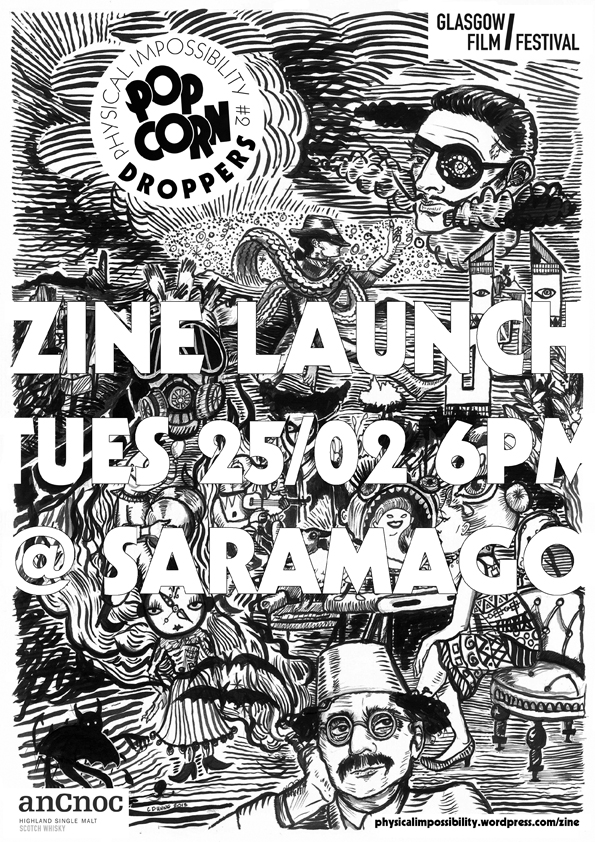
I’m also very excited to be launching issue two of my Physical Impossibility cult movie zine during the festival. The launch is going to be at Saramago @ CCA on Tuesday 25/02, 18:00-20:00. Up-to-date details can be found at the Facebook event page here. Physical Impossibility is also a featured zine at the Central Station website – read their preview here. The launch is the same evening as two other GFF events at CCA – the free but first-come-first-served Film/TV Locations: Scotland on Your Screen at 18:30 and the Andy Diggle and Jock in Conversation event at 20:00 – so if you’re in the area, feel free to drop in for a wee whisky and maybe pick up a zine!

Poster_final_web

Posted in GFF 2014, GFT, Glasgow, Interview, Movies, Reviews, Working Hard/Hardly Working, Zine | Tagged , , , , , , , , | Leave a comment

ZINE: Physical Impossibility #2: Popcorn Droppers

Poster_final_web

Physical Impossibility #2: Popcorn Droppers is almost here! The zine will be launched at Glasgow Film Festival on Tuesday 25th February, 18:00-20:00 at Saramago @ CCA.

Physical Impossibility #2: Popcorn Droppers explores the wonderful world of the too-weird-to-live movie, including Tim Burton’s Superman Lives, Russ Meyers’ Sex Pistols movie, Who Killed Bambi?, Salvador Dali’s script for the Marx Brothers, Giraffes on Horseback Salad, Michael Jackson’s Doctor Who, Mac and Me 2 and Nick Cave’s Gladiator 2 (“I enjoyed writing it because I knew on every level that it was never going to get made… It’s what’s called a popcorn dropper.”).

Popcorn Droppers features original writing by Sean Welsh, Ryan Balmer, Matt Carman, Craig McClure, Paul McGarvey and Harriet Warman with original illustrations from Laura Aitchison, Ciara Veronica Dunne, Stephen Kelly, Paul Jon Milne, Jack Somerville, ID Stewart and Kseniya Yarosh.

Zines and prints will be available for the first time at the launch, which is sponsored by AnCnoc Whisky.

Up-to-date details on Facebook.

Posted in GFF 2014, Glasgow, Popcorn Droppers, Zine | Tagged , , , , , , , , , , , , , , , | Leave a comment