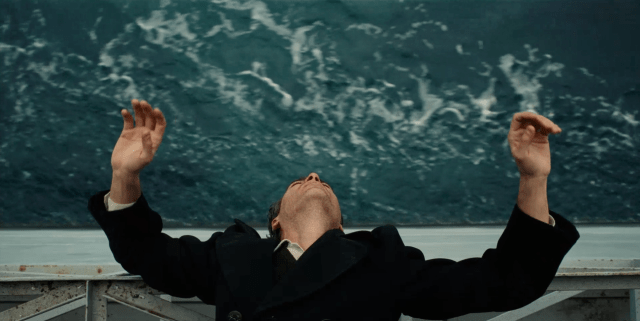
The Place Beyond The Pines (2012)

PLACE BEYOND THE PINES

“Especially in America, I think people are born into tribes. And I wanted to make a movie about two different tribes that end up colliding and then the reverberation of a violent episode. I wanted to do something about how you can’t get away from history. I wanted to make a film about that, but also deeply personal, about becoming a father and passing things on.”

Derek Cianfrance1

Derek Cianfrance’s ambitious third feature, after the little-seen Brother Tied (1998) and his breakthrough film Blue Valentine (2010), is a triptych, concerned with personal responsibility, family and, above all, legacy. Where Brother Tied was concerned with siblings and Blue Valentine husbands and wives, The Place Beyond The Pines (Dir. Derek Cianfrance, 2013) is about fathers and sons. All three films are intensely personal and chiefly preoccupied with the psyche of the modern American male. Where the director’s latest differs is in its grand scope – quasi-epic and generation-spanning – which seems to invite similarly grand analysis, while attempting to sustain the same specificity and intimacy of his previous films.

Brother Tied, made when Cianfrance was 23, remains unreleased, expensive music rights barring it from an audience wider than a largely appreciative film festival circuit. Telling the story of a man torn between allegiance to his brother and a newfound friend, it’s black and white, technically precocious and arguably overambitious. 15 years later, the director has been frank in his own analysis, saying, “It was all about my tricks as a filmmaker… It was content illuminating form instead of what I’ve learned since then, what I learned sitting on the bench, sitting in the cinematic desert, was that form is there to serve content.”2 Lesson learned, Cianfrance’s next effort arrived 12 years and 66 script drafts later.

tpbtp

Cianfrance’s devotion to authenticity – he ensured his The Place Beyond The Pines stars were surrounded “with the real people that made up the fabric of Schenectady, with real police officers, with real judges, with real bank tellers who had been robbed before”3 – is consistent with the approach he established with Blue Valentine. The production was famously method – the film’s leads, Ryan Gosling and Michelle Williams, lived together in preparation for their roles as husband and wife. Cianfrance had them live on a budget equivalent to their characters’, take family portraits and stage arguments. As with The Place Beyond The Pines, the director encouraged his actors to build their own characters, collaborate on their wardrobe choices and redraft or abandon the script entirely. Much of the film’s dialogue was improvised, with some scenes entirely unscripted. The focus was tight upon the couple in question and the result was almost brutally intimate and punishingly unromantic.

Cianfrance has discussed his various inspirations for the form of The Place Beyond The Pines – notably Abel Gance’s Napoleon (1927), a narrative triptych itself and hugely technically ambitious, and Psycho (Dir. Alfred Hitchcock, 1960) for its mid-film switch between protagonists. Napoleon is an historical epic while Psycho hinges around the shock death of the apparent lead character and both were formal trailblazers. Cianfrance’s challenge in making The Place Beyond The Pines was to take the intimacy, tight focus and emotional honesty of Blue Valentine and marry it to a more formal, even artificial structure. He worked on 37 drafts of the script with two other writers over several years before letting his actors loose on it.

PLACE BEYOND THE PINES

The title, courtesy of co-writer Ben Coccio, is a loose translation of the name of the film’s locale, Schenectady, a word of Mohawk derivation, roughly meaning ‘beyond the pine plains’ – as the area was defined from the perspective of nearby Albany. The choice of title subtly frames the narrative in the context of America’s bloody history and gives deeper resonance to the interior conflicts of the film’s protagonists. Cianfrance has said, “Thinking about how brutal our ancestors had to be, the brutality and ruthlessness with which this country was founded on, I think about now – we’re very civilised and domesticated, but I don’t think that ever goes away.”4 The director, who was shortly to become a father for the second time as he began working on the script, saw a correlation with a sense of the inescapable legacy passed from parents to children.

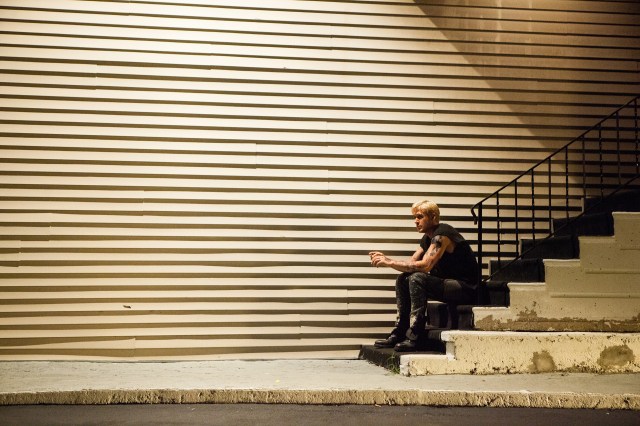
Cianfrance’s formal conceit allows him to fully realise his theme of legacy, and particularly paternal responsibility. The two contrasting ‘tribes’ – of Luke Glanton (Ryan Gosling) on one side and Avery Cross (Bradley Cooper) on the other, represent two sides of the same coin. One struggles with paternal absence, the other with presence – Luke wants to be there for his son as his father was not for him, while Avery struggles to escape his father’s long shadow. Each is defined by their desire to define themselves in opposition to their fathers, and their tragedy is that their efforts only perpetuate the cycle they wish to break, leaving it to the next generation to begin the struggle anew.

tpbtp4

Cianfrance’s artifice in tying together the two families with Luke’s early demise at the hands of Avery and Luke’s final decisive act, requesting his son not be told about him, sets the stage for the film’s resolution. 15 years into the future, Luke and Avery’s sons are grown and dealing with familiar issues in different ways – Luke’s son Jason (Dane DeHaan) has a caring father figure in Kofi (Mahershalalhashbaz Ali), but somehow feels the absence of his biological father. Avery’s son AJ (Emory Cohen) seeks to define himself in opposition to his distant father, now running for New York State Attorney General.

Cianfrance’s conclusion is formally apposite, with both Jason and AJ seemingly coming to terms with their respective legacies in positive ways – Jason eschewing bloody revenge for his father’s death and the previously thuggish AJ standing besuited by his father at an event. Truthfully, though, the ending is not uncomplicated. The transformed AJ seems uncomfortable joining his still-distant father. Jason meanwhile hits the road on a motorbike, having been sold a romanticised vision of his father by Luke’s erstwhile partner-in-crime. How either will fare is an open question, though Cianfrance implies it’s in the nature of these things to evolve rather than resolve.

Sean Welsh, November 2012
This article was originally commissioned as a programme note by GFT.


Footnotes

1. Derek Cianfrance, DP/30 interview
2. Derek Cianfrance, Slashfilm.com interview
3. Derek Cianfrance, Making Of interview
4. Derek Cianfrance, DP/30 interview

Posted in Cinema, Film, GFT, Glasgow, Movies, Programme Note | Tagged , , , , , , , , , , , , , , , , , | Leave a comment

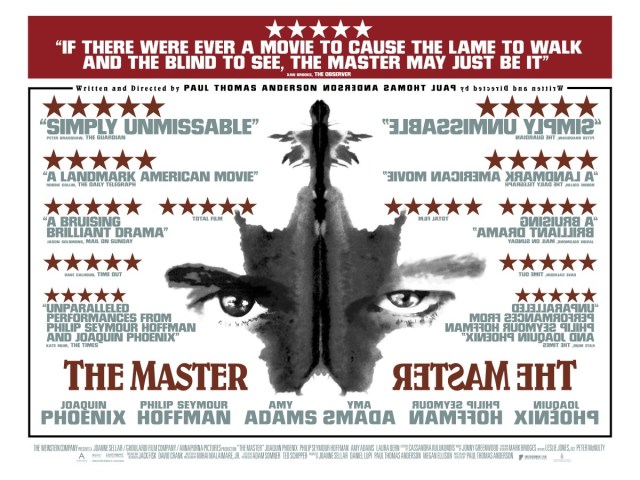
The Master (2012)

master

The Master (Dir. Paul Thomas Anderson, 2012) was always going to be a high profile project, following the celebrated director’s Oscar-laden There Will Be Blood (2007) and being the latest addition to a CV that includes Boogie Nights (1997), Magnolia (1999) and Punch-Drunk Love (2002). But when it was revealed that Anderson would be drawing inspiration from the life of L Ron Hubbard, interest in the project exploded across print and online media at a pace only matched by the insidious rise of Hubbard’s controversial Church of Scientology.

Hubbard, originally a pulp fiction writer by trade, evolved the tenets of Scientology from a self-help system he named Dianetics, first presented to the public in a magazine called Astounding Science Fiction. Since the publication in book form of Dianetics: The Modern Science Of Mental Health in 1950 (referred to amongst Scientologists as Book One, in the same fashion as The Master’s The Split Sabre is referred to as Book Two), Scientology has spread in scope, claiming up to 15 million followers worldwide (although this figure has been firmly contested). The organisation has routinely faced accusations of being a harmful cult with a commercial focus, but has long since outgrown its questionable roots, gaining considerable influence in the US particularly.

master-uk

The religion (still not officially recognised as such in the UK), has never been short of publicity. Popular interest in the organisation has been continually stoked, from the leaking in the early 1990s of documents purporting to reveal the extra-terrestrial mythology underpinning the faith (information usually only obtainable to the most advanced members of the church, also reportedly those with the deepest pockets) to material such as the bizarre video featuring one of the world’s biggest movie stars, created for a faux-award ceremony in his honour. What elements of the stranger-than-fiction story would make the screen? Most tantalisingly, what would Tom Cruise, Scientology’s most high-profile adherent and erstwhile star of Anderson’s Magnolia (1999) make of The Master? The ever-present threat of legal action by the hyper-vigilant and extremely litigious organisation added still more drama to the production underway.

However, while there may yet be a movie that does justice to the saga of Scientology, with all of its grim fascination, Anderson’s film is no more definitive than Battlefield Earth (Dir Roger Christian, 2000), the much-pilloried adaptation of one of Hubbard’s less pervasive works. Ultimately, The Master is a much more subtle and complex proposition, no more and no less ‘about’ Hubbard and Scientology than Boogie Nights can be considered simply as a portrait of the American porn industry. There are other elements to Anderson’s film that are of equal importance.

anderson

Exerting more of an overt influence on the fabric of The Master is John Huston’s Let There Be Light (1946), a documentary commissioned by the US Government and subsequently suppressed by the Army upon completion. Focussing on US soldiers undergoing psychiatric treatment necessitated by their experiences in World War II, sequences and dialogue from it were lifted wholesale for inclusion in related scenes in Anderson’s film. Anderson also reportedly drew upon wartime stories told to him by Magnolia star Jason Robards (who once woke up on the mast of a ship, having partaken of homemade ‘torpedo juice’) and the life of writer John Steinbeck, who worked, as Freddie Quell (Joaquin Phoenix) does, in Californian sugar beet fields.

The Master’s focus on the entirely fictional Freddie, away from Lancaster Dodd (Philip Seymour Hoffman), Anderson’s rhyme for Hubbard, was reportedly suggested by Hoffman, who has appeared in all but one of Anderson’s six films to date. Although there are several clear relations between Scientology and Dodd’s The Cause (the time period seems almost exact, several biographical details jibe and the ‘processing’ undertaken in the film is a clear analogue for the ‘auditing’ practiced by Scientologists), Anderson is clearly less concerned with a simple, though fictionalised, retelling of events than he is with pursuing themes that have consistently preoccupied his work.

master-4

Dysfunctional families – and particularly surrogate fathers – recur time again in Anderson’s films. Hard Eight (1996), Boogie Nights and There Will Be Blood all feature central characters who take younger men under their wings with questionable motives. Punch-Drunk Love and particularly Magnolia are driven by the frustration and anguish wrought by overbearing or irresponsible relatives on their protagonists. In all of his films, Anderson’s characters seem to struggle with their sense of self and how that is defined by the relationships they seek out. In Dodd’s espousal of his quasi-religious quack psychology, Anderson has found an apposite context for exploring these issues. It could be said that the burgeoning success of Dodd’s philosophy is explained by the same basic human need that drives Dodd and Freddie together, and the credibility of The Cause is mirrored in the summation of their relationship.

As should perhaps be clear from the title, The Master is concerned with the dynamics of interpersonal relationships and the shifting balance of power exerted within them. Dodd is referred to explicitly as ‘The Master’, but a question remains over who is truly in control at any one time, or who ultimately prevails. His charm, persuasiveness and general success is evident and those around him treat him deferentially. And yet, at several points, his confidence and power is shown to be illusory, compromised at best. His confidence does not extend to blithe rebuttal when he is put on the spot – twice he loses his composure and lashes out when his authority is competently threatened – and it’s clear his wife, Peggy (Amy Adams), exercises considerable influence over him herself.

The desire to abdicate responsibility to a higher power – be it in a moral, religious or family context – is universally powerful. Dodd is self-consciously fulfilling a role that he is superficially suited for, but full of human flaws as he is, cannot justify. By allowing and encouraging the incursion of Freddie into their lives, Dodd is inviting a challenge to his power in order to prove it – for what is a master without a servant? – but also perhaps to relinquish it. In the end, Freddie’s rejection of Dodd and The Cause is a qualified triumph. Returning once more to the base pursuits that have driven him all along, he may not be the master of himself, but at least he’s rid himself of the illusion of control.

Sean Welsh, November 2012
This article was originally commissioned as a programme note by GFT.

Posted in Cinema, Film, GFT, Glasgow, Movies, Programme Note | Tagged , , , , , , , , , , | Leave a comment

McCullin (2012)

mccullin

“Photography is the truth, if it’s being handled by a truthful person.”
Don McCullin1

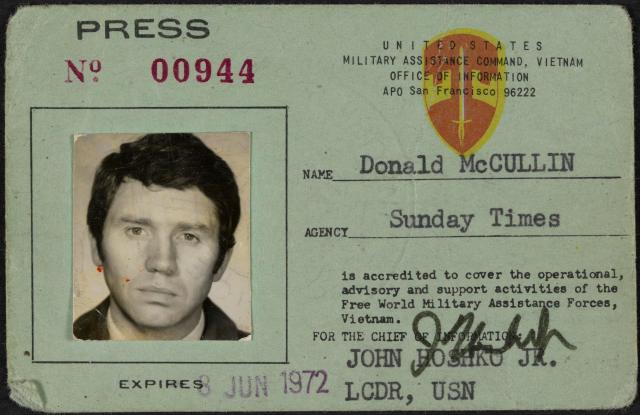
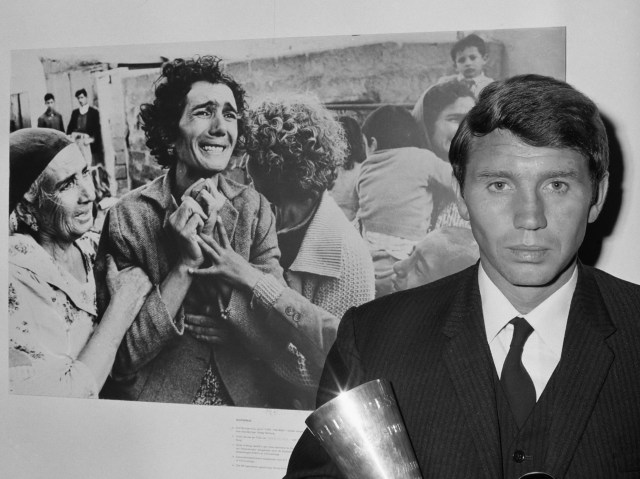
The story is told that, upon viewing an exhibition of Don McCullin’s work, Henri Cartier-Bresson approached the photographer to say, “I have one word for you – Goya”. Between 1810 and 1820, the Spanish painter Francisco Goya made a series of prints later commonly and collectively known as The Disasters Of War. One of these, typically depicting atrocities of the Peninsular War between France and Spain, is entitled Yo Lo Vi – ‘I Saw This’. Although it’s unlikely that Goya was present at all the scenes depicted in the series, it’s this sense of bearing witness that permeates the whole. And though Don McCullin frequently resists the suggestion that what he does can be considered art – “I have a strong creative desire but I’m not trying to be an artist.”2 – the painter’s words are of course implicit in every frame of McCullin’s that is printed and published, and their meaning is evident.

The Disasters Of War was not published until 35 years after Goya’s death, when it was politic to do so, and the perceived freedom with which Goya undertook his work (knowing it would not be disseminated in his lifetime) grants it an air of unconstrained, brutal veracity. Cartier-Bresson’s oft-quoted comparison of Goya’s work and McCullin’s – both bodies of work being preoccupied with depicting and relating the atrocities of war – is almost a cliché by now, but the crucial difference is the question of the relative responsibility, even culpability of the artist/photographer.

McCullin poster

With that in mind, it’s perhaps serendipitous that McCullin (Dir. Jacqui Morris, David Morris, 2012), concerned with documenting the long career of one of the world’s most respected photojournalists, should arrive at a time when the moral obligations of such photographers are once more under scrutiny. That long-running debate was recently reignited with the controversy over rather macabre photographs published on the cover of The New York Post, depicting the final moments of a subway passenger, seconds from gruesome, untimely death. R Umar Abassi’s photographs, published in early December 2012, immediately drew criticism for the paper, but more particularly the freelance photographer.

Abassi was accused of negligence in not helping the man, who had been pushed on to the tracks. The photographer countered that he had attempted to signal the driver of the approaching train by firing off his flash, while the Post suggested he would not have been strong enough to pull the man to safety.3 Nevertheless, the ensuing outcry called to mind a similar furore over Kevin Carter’s Pulitzer-winning 1993 photograph of a starving Sudanese toddler, shadowed by a nearby vulture. That photograph also attracted heavy criticism of Carter for his perceived failure to intervene (Carter killed himself just over a year later; in his suicide note he blamed money woes while stating, “I am haunted by the vivid memories of killings and corpses and anger and pain, of starving or wounded children, of trigger-happy madmen, often police, of killer executioners.”)

mccullin-02

Resisting the temptation to overload McCullin, brother and sister directing team Jacqui Morris and David Morris have chosen to focus primarily on the photographer and his own work, the only other onscreen interviewee being his Sunday Times editor, Sir Harold Evans. The result on one hand is to foreground the work itself, a wise decision given the overwhelming power of the imagery on display. On the other hand, the stated and perhaps obvious intention of the filmmakers is to provide McCullin the opportunity to “tell the story of his emotional journey behind the camera’s lens.”4

This is McCullin’s perspective on his life’s work, and an opportunity for him to make account of his actions. The photographer is not a religious man (as he has said elsewhere, “I am a professed atheist, until I find myself in serious circumstances.”5), but nevertheless a thoughtful and self-questioning one. The film could easily have the air of the confessional, if the photographer had not developed such a keen sense of his role and its worth. McCullin is also clearly aware that his compulsion to bear witness and record what he sees is perhaps precipitated by more selfish desires – the adrenaline rush of action for one – but doesn’t seem to need external approval or forgiveness.

Donald McCullin (1964)

“I have been constantly accused,” he explains, “of taking terrible pictures and people saying, did you ever help anyone? Of course I did, but I don’t want to brag about it.”6 Addressing the Goya comparisons directly, McCullin is typically confident in his response: “It wasn’t my fault if in Sabra and Shatila the light was almost biblical, if what happened in front of my eyes was like a scene out of Goya. I wasn’t there to make icons. I had to bring back information that could possibly prevent other such miseries.”7

McCullin retired from war photography in 2003. The close of the documentary (the interviews with him were filmed in 2011) finds him explaining that the country landscape he now calls home is his ‘heaven’ and that, “I’m going to spend the rest of my life trying to eradicate the things we’ve been talking about.”8 However, in late 2012, McCullin journeyed to Aleppo in Syria to document the ongoing civil war there. That conflict has claimed upwards of 40,000 lives to date, while 72 journalists have lost their lives reporting on it, among them McCullin’s fellow Sunday Times journalist Marie Colvin.

There’s undoubtedly some truth in the self-diagnosed war addict’s joke that “sometimes you just want to get away with the boys,”9 but something calls to mind McCullin’s vivid description of the old photographs stored in his home, and how those images haunt him as if they were happening today. However, reminded of his previous claims of retirement, he asserts the trip was, “Without any question of doubt, a last look at war and conflict, and pain and hunger.”10 He concludes, “I’m not going away with a negative image of my own personality – I’m not important in all this, I’m just the carrier pigeon that brings the message back home. I do still have a very good eye, I can see things.”11

Sean Welsh, December 2012
This article was originally commissioned as a programme note by GFT.


Footnotes

1. Don McCullin in McCullin (Dir. Jacqui Morris, David Morris, 2012)
2. Don McCullin, ‘Shaped By War: Don McCullin In Profile
3. ‘Anger At New York Post Cover Of Subway Passenger Seconds From Death
4. Jacqui Morris, Director’s Statement, McCullin Production Notes
5. Don McCullin, interviewed by Frank Horvat
6. Don McCullin in McCullin (Dir. Jacqui Morris, David Morris, 2012)
7. Don McCullin, interviewed by Frank Horvat
8. Don McCullin in McCullin (Dir. Jacqui Morris, David Morris, 2012)
9. Don McCullin, interviewed by Carole Cadwalladr
10. Don McCullin on BBC Radio 4’s Front Row
11. Ibid.

Posted in Cinema, Film, GFT, Glasgow, Movies, Programme Note | Tagged , , , , , , , , | Leave a comment

Barbara (2012)

Barbara

“We didn’t want to film a portrait of an oppressed nation and then juxtapose it with love as this innocent, pure and liberating force. We didn’t want any symbols. You just end up decoding them and what’s left is what you knew all along.”
Christian Petzold1

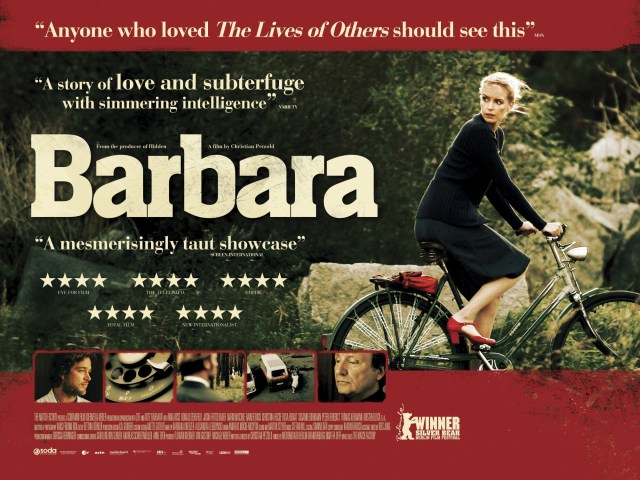
The incipient romance presented in Barbara (Dir. Christian Petzold, 2012) is far from innocent, conducted as it is in interrogative exchanges loaded with double meaning and uncertain intent. Petzold has spoken of the inspiration he took from the Bogart/Bacall classic To Have And Have Not (Dir. Howard Hawks, 1944), with its depiction of a burgeoning love affair in wartime Martinique under the Vichy regime. In both films, the terms of courtship are determined by the all-enveloping milieu the two leads have long since become inured to. The difference is that the dance performed by Barbara (Nina Hoss) and André (Ronald Zehrfeld) is more tense with suspicion than taut with sexual tension. Petzold, meanwhile, doesn’t allow his film to become freighted with allegorical dead weight and the early-established sense of everyday life in Barbara qualifies the insidious presence of Stasi control.

Petzold is perhaps the most prominent of the Berlin School of German filmmakers, initially connected by their common ties to the Deutsche Film und Fernsehakademie and linked further by a perceived opposition to the kind of contemporary German filmmaking most familiar to British and international audiences. The likes of Goodbye Lenin (Dir. Wolfgang Becker, 2003), Downfall (Dir. Oliver Hirschbiegel, 2004), The Lives Of Others (Dir. Florian Henckel von Donnersmarck, 2006) and The Baader Meinhof Complex (Dir. Uli Edel, 2008) have lately provided English-speaking audiences with a steady stream of populist drama, largely preoccupied with post-war, pre-unification Germany.

barbara

On the other hand, Petzold’s oeuvre to date – including The State I Am In (2000), Yella (2007) and Jerichow (2008) – has focussed on contemporary, urban Germany with a quality of coldness approaching frigidity, “seeking new, truer images for post-Wall Germany and its suppressed tensions”2. Petzold has previously forsworn period filmmaking, explaining, “You have so much to reconstruct – the music, for example, the everyday objects, and then, in the end, it so often comes off looking like a caricature.”3 It is unusual therefore that, with Barbara, he should attempt to conjure the world of rural East Germany in the early 1980s.

Barbara is the director’s sixth film (not counting his TV work, of which his contribution to the Dreileben trilogy screened at GFF12) and his fifth collaboration with star Nina Hoss. For Barbara, Petzold was inspired by his own heritage and memories of East Germany as a child (his parents fled to the west before he was born, later taking holidays in the GDR). The director inherited his parents’ desire to fit into their new surroundings, but also their sense of estrangement. However, as Petzold has explained, “I did not want to reconstitute the GDR, my film was not about reenactment and high-precision historical drama.”4

Christian Petzold

Although Barbara’s dilemma is culturally and historically specific, her motivations and behaviour largely defined and dictated by her environment, Petzold’s film has a quality of immediacy rather than distance. Barbara transcends historical specificity partly because it initially resists too-obvious indicators of time and location. Instead, Barbara traverses a rural landscape happily lacking the drained tones and coded grays audiences have come to expect from cinematic depictions of the GDR.

Cycling, furtively concealing items under rocks, refusing social overtures (her distance taken for snootiness) – if it wasn’t for the fruitless though nonetheless disturbing interventions of the Stasi, it would be easy to take a child’s view of this milieu – why does this woman behave so strangely? Barbara is so often alone in nature that the strangeness of the behaviour inspired in her is foregrounded. The effect is to expose the pervasive psychological grip the Stasi held on ordinary life. Petzold notes, “All that fear and suppression was happening between the people. That’s where it worked. All the beauty, love and liberty were poisoned by mistrust.”5

barbara

Motives are suspect from the outset. A key exchange finds André sharing an intimate and disturbing story regarding his fall from professional grace. He’s apparently laying himself bare, but a sceptical Barbara responds by interrogating him on the details of his story. In replying, André’s tone is not wounded, or reproachful, but instead approximates resignation – “Was my story too long? Too neat?” Barbara still resists his overtures, as she resists the opportunity to empathise with the Stasi officer whose wife is revealed to have terminal cancer.

Later, André recommends a book of short stories – Turgenev’s A Sportsman’s Sketches – and tells her of his favourite, The District Doctor, in which an “ugly old doctor” treats a terminally ill young woman, who professes her love for him. The casual relation of the story is charged with almost imperceptible provocation – upon the death of his patient, the doctor returns to his wife. He has been merely a cipher for the girl, allowing her to project the love she has never and will never have. So is André to be Barbara’s cipher, a stand-in before she returns to her ‘real’ life? Or is it vice versa? Perhaps tellingly, Turgenev’s tale is as much about the doctor as the patient – he willingly, to his apparent shame, participates in the charade after becoming infatuated with the young girl. Zehrfeld’s subtle performance has by this point substantially humanised the potentially duplicitous André, in our eyes and, crucially, Barbara’s. His story is superficially inconsequential, but on another level is a question that she must answer. Therefore the moment when they kiss has been thoroughly prefaced subliminally though never vocally, and when André says, carelessly, “I’m so happy you’re here,” his words are enough to precipitate their sudden embrace.

However, when Barbara finally elects to stay, it’s not the triumph of love, nor a fatalistic capitulation nor, least of all, a renunciation of the West. Barbara chooses self-determination (an early indicator is her silence as her erstwhile lover explains she won’t need to work once she’s escaped) and as she gives up her chance of escape, there’s a sense of relief and a shift in the balance of power, though the status quo ostensibly remains. It could easily be tragic, but instead feels quietly triumphant.

Sean Welsh, October 2012
This article was originally commissioned as a programme note by GFT.


Footnotes

1. Christian Petzold, Director’s Statement on Barbara
2. Nick Hasted, ‘In The Shadow Of The Wall’, Sight and Sound, October 2012, p48
3. Christian Petzold, interviewed by Anke Westphal
4. Christian Petzold, interviewed by Bénédicte Prot
5. Christian Petzold, Director’s Statement on Barbara

Posted in Cinema, Film, GFT, Glasgow, Movies, Programme Note | Tagged , , , , , , , , , , , , , | Leave a comment

Martha Marcy May Marlene (2011)

martha-marcy

As hinted by the tongue-twisting title, Martha Marcy May Marlene (Dir. Sean Durkin, 2011) is primarily concerned with one woman’s struggle with a splintered sense of self in the immediate aftermath of her escape from a cult. Once Martha (Elizabeth Olsen) extricates herself from the farmhouse in which John Hawkes’ Charles Manson-like Patrick has built a ‘family’ around his Buddhist-derived teachings, she finds reacclimatising herself to ‘normal’ life problematic. Unlike most films that depict cults, Martha Marcy May Marlene is concerned with accurately depicting the experience of someone who is first drawn to such an out of the ordinary lifestyle and then ultimately struggles to free themselves, physically, psychologically and emotionally. In the process, writer-director Durkin humanises, if not normalises, the public perception of cult members most infamously personified by the Manson Family.

The film is a psychological thriller in the purest sense of the term, because the film projects for the viewer an exploded sense of Martha’s psychology in her first days outside of the cult. What has happened in her life before is clearly important – several references are made to her family life before the cult – though expository details are never made forthcoming and how her life will be in the future is left entirely open-ended. In a fashion similar to that employed in We Need To Talk About Kevin (Lynne Ramsay, 2011), the sound design of the film draws us into the protagonist’s frame of mind, as aural triggers plunge her back into her memories. In Ramsay’s film, the technique communicated how the memory of certain past events affects the experience of the present, while memories can themselves become charged and tainted with the full knowledge of what those remembered events portend. Both films give a sense of a character trapped by the past and in the midst of a battle to transcend it.

mmmm-poster

However, Martha Marcy May Marlene’s use of flashbacks is more than a storytelling device, although of course they function that way for the viewer. More fundamentally, they relate Martha’s psychological state. Her difficulty in discerning what is real and what is remembered – and what she is truly experiencing in the present time – demonstrates her destabilised identity. For the duration of the film, from one moment to the next, Martha’s perspective literally fluxes between place and time and psychological states. We necessarily share Martha’s confusion with temporality – the linear nature in which we normally experience life – as the film jumps back and forth from Martha’s time at the farmhouse to her sister’s lake house, while scenes at either location almost seamlessly overlap. As Durkin has explained, “For her it’s all happening at the same time so it is all in the present.”1 With only a handful of scenes between Lucy (Martha’s sister, played by Sarah Paulson) and her husband providing a sense of objectivity, the viewer shares Martha’s skewed perspective of time and space.

There are also subtler echoes of Patrick’s twisted take on Buddhist philosophy. In her time with the cult, Martha was indoctrinated with the belief that ‘Being in the moment is the most important thing, [to] forget about time, forget about any desires or goals.’2 Once she has left to reunite with her sister, Martha continues to struggle to disassociate that which she has believed and invested in – essentially how she had chosen to life her life – from the more problematic aspects of her cult experience. Specifically, the violent events that appear to trigger her escape have not completely undermined the worldview that she had adopted.

MMMM_Day06_20100901_GF1434Z6046.CR2

While the film is ambiguous in its depiction of the paranoia that afflicts Martha – her terror at the various sightings of an ominous van that she clearly relates to the cult and strange men who seem to follow and watch her – Durkin has spoken of the inspiration for his film’s narrative angle being the true story of one cult escapee. That ‘Martha’ was tracked down by the leader of the group (In Martha Marcy May Marlene, it’s Watts (Brady Corbet) who fulfils this role) who, rather than threatening her, gave her money and wished her well. The director describes it as “A complicated, twisted way of letting someone go,”3 inferring that the cult’s threat to Martha is not immediate and/or physical, but more insidiously psychological.

The abrupt ending has caused some to suggest – as they have done over the famously ambiguous endings to Inception (Christopher Nolan, 2010) and TV’s The Sopranos – that a clear, although of course debatable, meaning can be drawn. After a final, strange appearance from a young man driving a people carrier (which seems even to unsettle Martha’s sister and her husband), the film cuts to black on Martha’s anxious expression. The implication some have drawn is that constant paranoia will be Martha’s lot for the rest of her life.

mmmm3

Instead, it could be argued, in keeping with the concept that the film represents an exploded or expanded psychological state that, in fact, the film is genuinely open-ended and simply intends to depict Martha’s state of mind in a particular time frame. Whether she recovers completely, or is permanently damaged is left for the viewer to decide. When asked about the possibility that a more mainstream treatment of the subject matter would have given Martha a full recovery and eventual happy reintegration into society, Durkin responded, “That’s impossible in that time frame. That takes years.”4 Therefore, it’s clear the filmmakers’ focus was on a particular state of mind in a finite period of time.

Just as the cinema of David Lynch (particularly Mulholland Drive (2001) and Inland Empire (2006)) frequently takes on the quality of dreams – wherein the viewer ideally undergoes a process akin to lucid dreaming, immersed and sharing (as in the fanciful schema of Inception) a psychological space with the director and the protagonist – Durkin’s film blurs the line between the real and the imagined. Martha’s paranoia manifests itself in the way she projects perceived threats onto the real world and the viewer is invited to share this experience with her.

Sean Welsh, February 2012
This article was originally commissioned as a programme note by GFT.


Footnotes

1. Sean Durkin, Martha Marcy May Marlene production notes.
2. Ibid.
3. Ibid.
4. Sean Durkin, ‘Martha Marcy May Marlene Director, Producers Talk Cults, Time Shifts & Elizabeth Olsen

Posted in Cinema, Film, GFT, Glasgow, Programme Note | Tagged , , , , , , , , , , , , , , , | Leave a comment