Freedom of Seats (UPDATED)

Gremlins

Cineworld have decided to introduce allocated seating in their UK cinemas, reportedly from Friday 6th June, 2014. This is a terrible idea. This is nominally a film blog, so I’m not going to split hairs about what is and isn’t worth getting worked up over. However, since worse things certainly happen at sea, let’s keep it simple.

I have an Unlimited Card, which Cineworld recently upgraded to Premium by virtue of the fact I’d had it for a certain period of time. I love GFT (generally doesn’t allocate seats), have a lot of history with the Grosvenor (generally does) but regardless spend a lot of time in Cineworld – enough time to make my monthly Unlimited Card direct debit seem excellent value for money. Nevertheless, I reckon this is a dumb, unnecessary move, and I’m not alone. The change was brought to my attention on Twitter, via fellow film geek, Ross Maclean:

Excellent question.  Sean Wilson over at Cineworld posted a blog explaining their reasoning for the change. It goes a little something like this:

Allocated seating is coming soon to Cineworld. Guarantee your seats when you book online or in the cinema itself.

And there are additional benefits to allocated seating too:

1) Peace of mind

Select your seats in advance and arrive at the cinema knowing your seats are reserved.

2) Sit with your friends

If you have booked as a group, you can be sure that you will be able to sit together.

3) Enjoy a more relaxed journey to your seat

With allocated seating you no longer need to compete with other customers for available seats in the auditorium. Plus, if you arrive late you won’t have to search in the dark looking for available seats.

4) Less queues, less congestion

More customers booking online in advance, means less people queuing in the cinema. Simply turn up with your reserved seats already booked, and print out your tickets from our ATM’s or go straight through to the cinema screen with a smartphone to display your ticket.

5) More choice

With allocated seating, you can choose where to sit; you can also choose the screening time with the best available seats.

Stay tuned to the blog for more details.

Sean kind of avoids explaining why this is getting brought in, but let’s look at the “additional benefits,” briefly, one by one.

1) This should appeal to me, because I’m one of those people who insists on sitting middle-middle, infuriating and bemusing anyone who accompanies me. However, given Cineworld cinemas are fairly democratic in the layout of their seating, it’s really never been an issue for me to sit somewhere else. Actually, to be fair, fuck sitting in the front row for something in the line of Transformers – that happened and I could barely follow what was going on. The proper take-away from that, though, is arrive in plenty of time to get half-decent seats and then it’s not an issue. Arrive late and you take your chances. Why cater to people who can’t be fussed arriving on time? Maybe the answer lies in those “still time to buy yourself a Coke”  adverts.

2) Never been a problem. And again, this works just fine managed by the audience – arrive on time, get yourself a seat together. Those that breenge in at the last minute should have to sit separately.

3) “A more relaxed journey to your seat” is a euphemism for “rock up when you feel like it”, which to me means two things. One, more people arriving just as the film starts or, having misjudged their clever advert-skipping, once it’s underway. So far so irritatingly disruptive. Two, finding people sitting in your seats regardless, which, obviously that will happen. So, a relaxed journey to your seat, followed by a terse conversation and then potentially fisticuffs. “Plus if you arrive late, you won’t have to search in the dark looking for seats” – really? Because everyone instinctively knows the seating layout.  This seems like a key flaw in the proposed change – allocated seating requires ushers – to show you to your seat, to intercede in any ‘discussions’ that arise and to resolve inevitable problems with double-booking (or mistaken booking, e.g. when people get confused over the layout and book front row seats when they thought they were getting back row). Will Cineworld be hiring more staff to meet this requirement? Seems unlikely.

4) “Less queues, less congestion.” This is bullshit filler on the list, because it already happens with online booking. I suspect more people booking in advance will only mean more and bigger queues at the lobby ATMs.

5) “More choice.” Two of the most irritating things in a cinema are someone much taller than you sitting in front of you and people being loud or obnoxious (in a variety of ways). Ordinarily, you can just move – or ask them to move if they’ve blithely picked the only seat in an empty screen which obscures your view. Not anymore!

There are generally pros and cons to Cineworld’s laissez-faire attitude. I don’t love it when the projection goes wrong and it takes 15 minutes for anyone to notice much less do anything about it once a punter tracks down an usher to tell them. Allocated seating also makes sense for events – e.g. theatre, sports, opera – and that includes any satellite events hosted or live-streamed by Cineworld. But good seats being available to those who arrive on time and sit through all the fucking adverts doesn’t strike me as a problem that needs addressing. Anyway, those are my first thoughts – it isn’t broken, so why fix it? Maybe this is only an issue for geeks like me who spend all their money on films and plenty of their spare time at the flicks. I’d love to hear from anyone that thought it was a good idea, and why.

UPDATE:

It seems to be almost upon us – a trip to see X-Men: Days of Future Past this weekend provided a fun demonstration of why allocated seating is such a wonderful idea in theory and practice. Three of us Unlimited Card holders wanted to see the movie and elected for a 19:50 3D screening because the preferable 2D screening at 20:00 was, according to the website, allocated seating. On arrival, we realised we’d screwed up by taking the confirmation code down wrong so we couldn’t collect our tickets at the machines – so far, so our dumb problem – but then noted that according to the screens in the foyer and the Cineworld app, that there was no 19:50 screening. Perhaps we’d totally fucked up. The guy on the desk tried to find our booking via the main card we booked with, but couldn’t. He reckoned maybe we’d booked for Parkhead by accident – we felt like idiots, but then that’s not totally unusual. We were rebooking for the 21:00 when I noted there wasn’t a 19:50 at Parkhead either. Upon hearing that, it occurred to one of the guys behind the desk (by then there were four staff members creasing their brows over our impossible problem) that they’d actually moved the screening to 20:00.

photo

So then we had our tickets, and though we were technically allocated seats (see above), we were to ignore them. The guy who finally sorted us out also confirmed that allocated seating is coming in on Friday 20th June (there was also  lovely A4 poster placed behind the ticket desk, demanding precisely nobody’s attention). I quipped that I’d be back then with my placard, and he replied somewhat tersely, and with a discernible hint of exasperation, “Just book online.” Upstairs, I somewhat dickishly asked the guy taking the tickets if I was seated in K12 (see above), and he confirmed that I was indeed.

There’s also now a Facebook page, Say No To Allocated Seating, gathering some traction (or at least the latest information) and providing a space for all the negative chatter about Cineworld’s plans. They have this to offer by way of explanation for why Cineworld are bringing it in, beyond the mealy-mouthed benefits laid out in their blog, above:

These are the facts as I understand them:-

1) The new Chief Executive is the driving force behind both Allocated Seating and Star Seating. He thinks that it is a good idea based on what happens in Eastern European cinemas.

2) Allocated Seating will be brought in despite the negative feedback from the General Managers and Regional Managers who realise the pitfalls and the problems it will cause.

3) Head Office is constantly changing the instructions on how this new policy will be carried out. For example, it was initially agreed that the main lights would be left on until the main feature starts thus facilitating the customer in finding their allocated seat. This now won’t happen.

4) After the initial 8 week period when staff will be in each screen to help seat customers, there will be no extra money available to enable this happen and cinemas will not be employing more staff to aid us either.

5) The new Allocated Seating policy has not been heavily advertised and as such the cinemas anticipate a lot of problems on site when it is introduced on 13th June. Long queues are expected.

6) There will not be any seating plans available for customers to see nor will we be able to view the seating plan on the screen at the box office etc. Staff will be instructed to ask “front, middle or rear”. (Their system may well allocate the actual seat).

7) Allocated Seating will mean that more people will rush to book in advance and as rules state that if a screen has over 20 seats sold the film can’t be moved to another screen or cancelled. For example – this means that many cinemas could not have added Pulp Fiction screens after the first sold out – customers lose out again.

8) Managers are against this but because there have been so many redundancies in recent years, they are too frightened to speak out.

9) Staff and Management realise the new policy will upset Unlimited Customers in particular but are powerless to do anything.

10) Although the new seating has already been purchased, instead of going ahead with a full roll out, the new Star Seating will be trialled in only 5 sites.

To be continued, I guess!

Posted in Glasgow, Movies | Tagged , , , , , , , , | 6 Comments

I Love Bad Movies #6

ILMB1

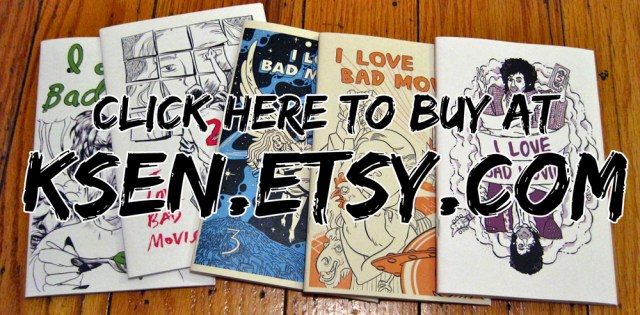
The latest issue of the I Love Bad Movies zine is here, and it’s the best news to come out of New York since I heard Viva Herbal Pizzeria on 2nd Avenue had unexpectedly shut. Admittedly, the bar was pretty low, because that was legitimately disappointing news. Nevertheless, #6 of the always awesome zine is here, this time featuring some writing by yours truly. Readers of the Physical Impossibility zine will be familiar with the editors of I Love Bad Movies, Matt Carman and Kseniya Yarosh, who contributed writing and illustration respectively to the Popcorn Droppers issue. They were also instrumental in getting Physical Impossibility stocked in New York, and are just generally super cool folks.

Volume Six of I Love Bad Movies is food-themed and features writing from – deep breath – Claudia Eve Beauchesne, Dan Berube, Matt Bird, Cristina Cacioppo, John Carman, Matt Carman, Matt Desiderio, Eric Epstein, Ezra Fox, Malaka Gharib, Kate Hutchinson, Guy J Jackson, James Jajac, Eleanor Kagan, M Sweeney Lawless, Kevin Maher, Laura Jayne Martin, Dan McCoy, Mary Regan, Claire Sanders, Bob Satuloff, Justin Shatraw, Rick Sloane, Chris Smith, Jay Stern, Matt Sullivan, Stuart Wellington, Timmy Williams and Kseniya Yarosh, not to mention illustrations by Erin Gallagher, Greg Rebis,  James Jajac, Mary Regan, Claire Sanders and Stuart Wellington.

As you may glean from the above list, with over 70 pages of content there’s more than plenty material to get your teeth into. My contribution, “A History of Bad Movies & Bad Snacks,” explores the causal link between terrible food and terrible movies. There’s also an essay on J&B Whiskey in Giallo movies, another entitled “Unfortunate Cinematic Sandwiches “, and a look at Death Bed: The Bed That Eats (1977). AND a recipe to make your own version of The Stuff! I’m thrilled to be involved with this issue, and I can heartily recommend volumes 1 through 5, all of which are still available to buy.

ILBMbuy

ilovebadmovies.com

facebook.com/badmovies

Buy I Love Bad Movies #6 at Etsy

I Love Bad Movies Etsy shop

Posted in Movies, Working Hard/Hardly Working, Zine | Tagged , , , , , , , | Leave a comment

Nick Cave’s Gladiator 2

Gladiator 2

Illustration by Jon Paul Milne

“I wanted to call it Christ Killer.”

Nick Cave

In a 2006 interview with Variety, musician Nick Cave was quoted saying, “The last thing I ever wanted to get involved with is Hollywood. The way it works is that people get an idea you could possibly do something, but there’s a one-in-a-hundred chance that it could get made. It’s a waste of fucking time, and I have a lot to do.” This was only a year after Cave’s script for The Proposition (John Hillcoat, 2005) had justifiably earned him plaudits and drawn the attention of the wider industry. Even then, Cave was no stranger to the film business, having cameoed in Wim Wenders’ Wings of Desire (1987) and Johnny Suede (Tom DiCillo, 1991) and contributed to a number of scores and soundtracks. But something had soured him on mainstream Hollywood – it might have been a simple clash of sensibilities, but just as likely it was the result of something dubbed “the Gladiator effect.”

Flashback to 2000, when Ridley Scott’s Roman epic had burst the box office and inspired a resurgence of the historical epic genre, as Hollywood predictably tried to repeat the trick. No-one should have been better prepared to do so than the the team behind the original film. There were, however, a couple of complications. Firstly and most problematically, not only had Russell Crowe’s titular Gladiator died in the first one, but also Scott’s film was fundamentally about death, with the main narrative drive being Maximus’s entwined desires for vengeance and sweet, Elysi-yummy release (although, presciently enough, not necessarily in that order). Any follow up featuring Crowe would have to do a merry dance in order not to completely undermine the first one, where all he really wanted to do was be with his family in the afterlife. Secondly, the Oscar-nominated script, ultimately credited to three writers, had been redrafted constantly on set, with the additional input of Scott, a host of producers and most famously Crowe himself, who reportedly told third official screenwriter William Nicholson, “Your lines are garbage but I’m the greatest actor in the world and I can make even garbage sound good.”

But success has many fathers, and everyone whose wallets weren’t quite fat enough from the first one had a solid gold idea for a follow-up. Producer Douglas Wick recalls getting a call from Crowe’s agent, just after Gladiator had won five Oscars, including Best Actor for his client. “I got a great idea,” he pitched, “How about we do a sequel and the beginning of the sequel, you see the part where they carry Russell’s body out of the arena and they get him right around the corner and Russell climbs down, they all shake hands and say, ‘Yeah, it worked, they believe I’m dead.’ And we could start the sequel.”

A prequel focussing on Maximus’ life as a soldier was also proposed, but ruled out due to the lack of gladiatorial action. Then, towards the end of 2003, Gladiator’s second original screenwriter, John Hodge (responsible for killing off Maximus’ family and the line “at my signal, unleash hell”), seems to have completed work on a script entitled Gladiator II: Blood of the Empire. Hodge’s take likely focussed on Lucius (Connie Nielsen’s son in the original), 15 years later, probing the ambiguity around his mum’s relationship with Maximus and possibly employing a Godfather Part II-style expansion of the first film’s narrative to take the story multi-generational.

None of those angles had panned out when 2004 saw a bumper crop of Gladiator-inspired movies, including Troy (Wolfgang Petersen), King Arthur (Antoine Fuqua) and Alexander (Oliver Stone). It can’t have been long after that Crowe, having championed and in fact almost signed up to star in The Proposition, called Cave to ask him to take a swing at Gladiator 2. “Hey, Russell,” Cave queried, “Didn’t you die in Gladiator 1?”

“Yeah,” Crowe retorted, “You sort that out.”

Cave’s resultant script opens with Maximus in purgatory, escorted by new character Mordecai (think Conductor 71 in A Matter of Life and Death) to a vast plateau doubling as a refuge camp for lost souls and hence to a ruined temple housing the dying gods. They take the piss out of Maximus (Jupiter does most of the talking) before offering to reunite him with his family, but only if he helps them out. Their power, it turns out, is being sapped by “an evil little idea,” namely growing faith in the Judeo-Christian god. So, according to Cave’s later summation, they want to send Maximus back “to kill Christ and all his followers.” He agrees, only for Mordecai to reveal his wife has given up her place in Elysium so that their son, Marius, can live again on Earth. Long story short, Marius turns out to be a Christian, menaced by a grown Lucius and unwilling to take up the sword to defend himself against religious oppression. With the help of old pal Juba, Maximus picks up the slack and saves the day, only to find himself cursed as an eternal warrior, an idea expressed through a climactic battle montage encompassing “all the wars of history,” from the crusades to Vietnam, culminating in a toilet in the modern-day Pentagon. Crowe’s response to Cave’s script? “Don’t like it, mate.” What about the end? “Don’t like it, mate.”

And so that was that. Ridley Scott and Russell Crowe teamed up again, first for Provençal rom-com A Good Year (2006) and again for Robin Hood (2010). The latter, alongside Scott’s Kingdom of Heaven (2005) may have decisively scratched whatever itch they had for a Gladiator sequel. Nick Cave has continued his collaboration with Hillcoat, providing the script for Lawless (2012), and prospectively an adaptation of Cave’s 2009 novel The Death of Bunny Munro. In 2006, he also confided to Variety, “I’m very comfortable in my day job as a musician.”

This article is taken from Physical Impossibility #2: Popcorn Droppers, which is on sale now from selected stockists. The zine features original writing by Sean WelshRyan BalmerMatt Carman, Craig McClure, Paul McGarvey and Harriet Warman with original illustrations from Laura AitchisonCiara DunneStephen KellyJon Paul Milne, Jack Somerville, ID Stewart and Kseniya Yarosh.

You can also buy a copy directly, here. It costs £4 + 90p postage within the UK (1st class Royal Mail). NB If you are an international customer, please contact sean.m.welsh@gmail.com prior to ordering, and I’ll get back to you with a postage quote.

btn_buynow_SM

image-1

Posted in Glasgow, Popcorn Droppers, Zine | Tagged , , , , , , , , | 1 Comment

INTERVIEW: David Bruce on Glasgow Film Theatre, 1974

GFT Foyer 1974

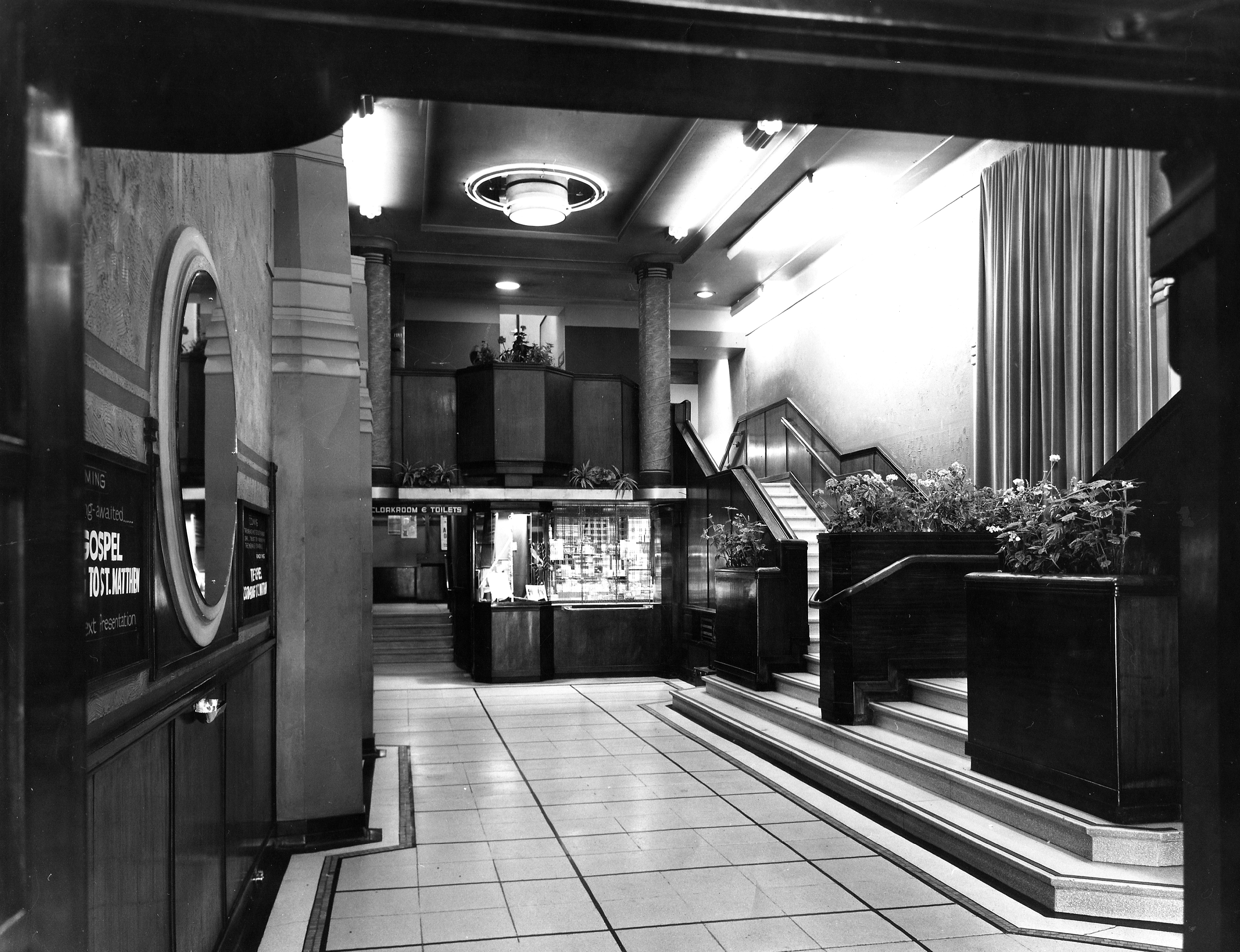
GFT’s shiny foyer, 1974. Pretty sure that’s a Pasolini listing on the left.

David Bruce, former chair of GFT, once director of the Scottish Film Council and Edinburgh International Film Festival and author of Scotland – The Movie, gave up his time to speak to me recently on the subject of the 1974 opening of Glasgow Film Theatre. In the early 1970s, Bruce was deputy director of the SFC, and part of the team that would set up the film theatres in Edinburgh, Dundee and Glasgow. The interview, commissioned by GFT, is timed to coincide with GFT’s 40th anniversary this year (also GFT predecessor the Cosmo’s 75th and Glasgow Film Festival’s 10th). You can read the final piece on their Cinema City site, here.

We spoke for a while, and since the topic was strictly-speaking the opening of GFT and the word count was pretty limited, there’s a lot that didn’t make the cut. For example, I was curious to hear how, at first, they did their best to introduce every screening at GFT. Bruce explained, “Every feature film, there would be somebody up in the sound box who would actually do a good evening and welcome and maybe say something over the PA about the film. We found that quite difficult to sustain, because it meant some poor sucker had to keep on doing it and some of us wanted to get home to our wives and children… We were always keen that there should be a life presence, a human presence in the cinema, as a way of making it different from the run of the mill.”

It was also interesting to hear how, before GFT became independent, the Scottish Film Council’s finances were tied to its ticket sales. “In some ways,” Bruce recalled, “it was a scary, maybe almost ridiculous, thing that the national agency’s capacity to support the culture was going to be depending on the box office from last week.” Nevertheless, he maintained the programming was not affected by this pressure. “I can honestly, hand on heart, say we never had any cause to compromise. We certainly didn’t increase the popular stuff to keep the budget. Rather, we stuck by our original ideas of how to do it and it panned out OK.”

Read more, including why GFT’s screens lasted longer than in your average 1970s cinema, and how GFT stayed the working man’s education while becoming the single woman’s cinema, all at Glasgow Film’s Cinema City site.

Posted in GFT, Glasgow, Interview, Movies | Tagged , , , , , , , , , , | Leave a comment

The Double Programme Note for GFT

Doublequad

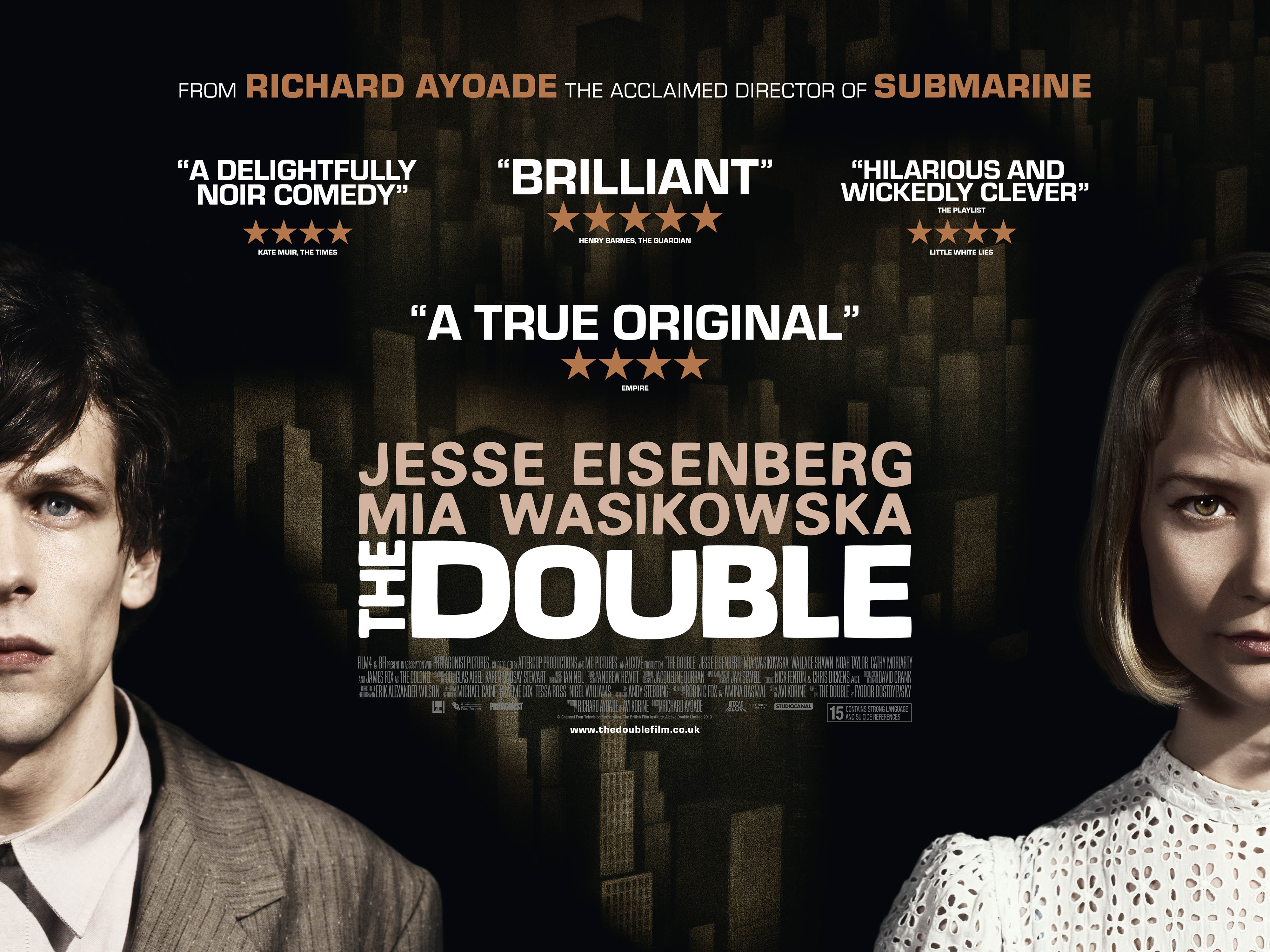
The Double (Dir. Richard Ayoade, 2014) is screening at GFT from today to Thursday 17th April. My accompanying programme note will be available at screenings – read it online here! GFT archives all its programme notes online here.

Posted in GFT, Glasgow, Programme Note | Tagged , , , | 1 Comment