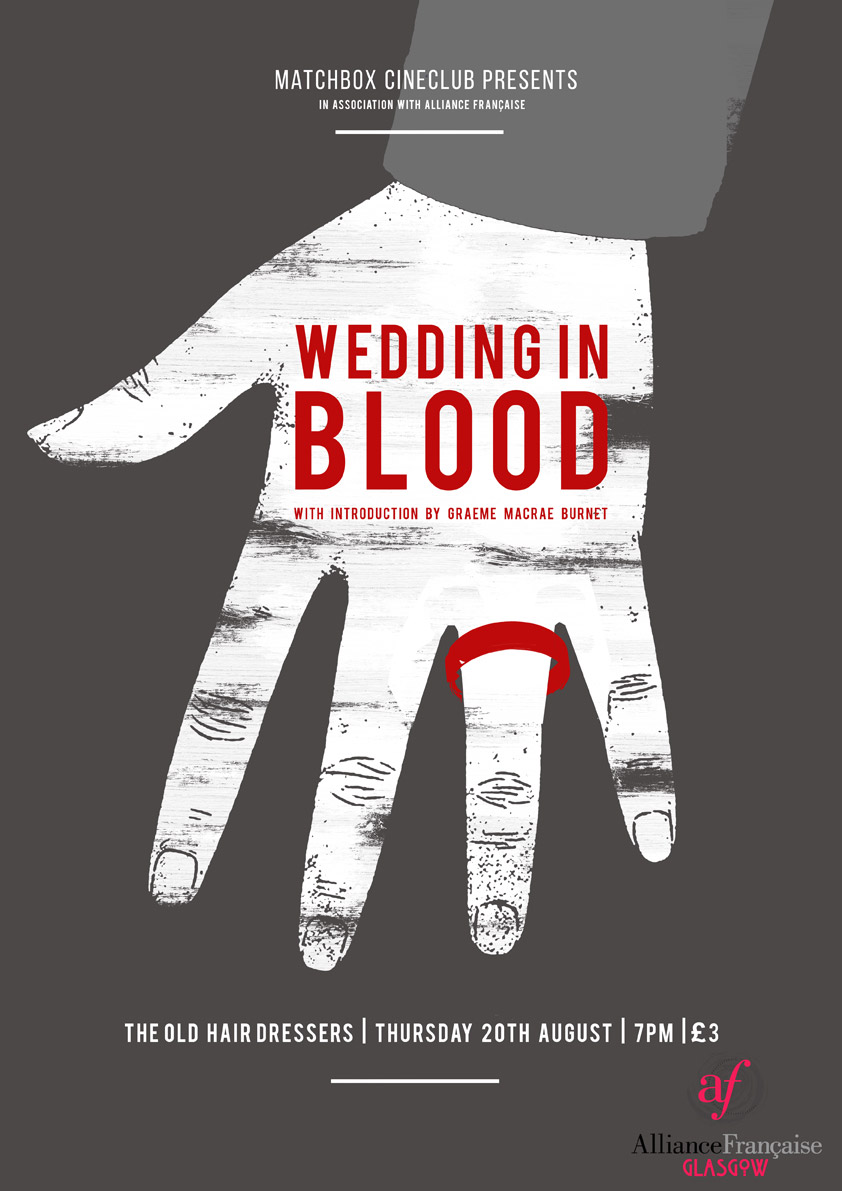
Matchbox Cineclub’s August screening, presented in association with Alliance Française de Glasgow, will be Claude Chabrol’s Wedding In Blood (Les Noces Rouges, 1973). It’s a rare chance to see Claude Chabrol’s classic portrait of an amour fou with deadly consequences in provincial France, starring Stéphane Audran and Michel Piccoli. The screening will be introduced by Graeme Macrae Burnet, author of The Disappearance of Adèle Bedeau, a literary thriller set in the small town of Saint-Louis in the Alsace.
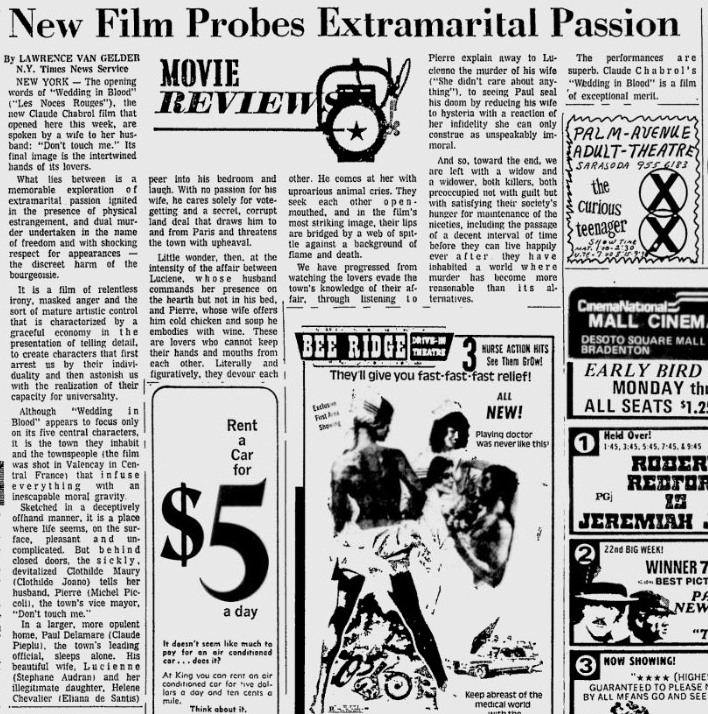
Original New York Times review
The screening takes place at 7pm on Thurday 20th August, in the gallery area of The Old Hairdressers, Glasgow. Admission is £3 via Eventbrite. This month’s screening is by arrangement with Artedis.
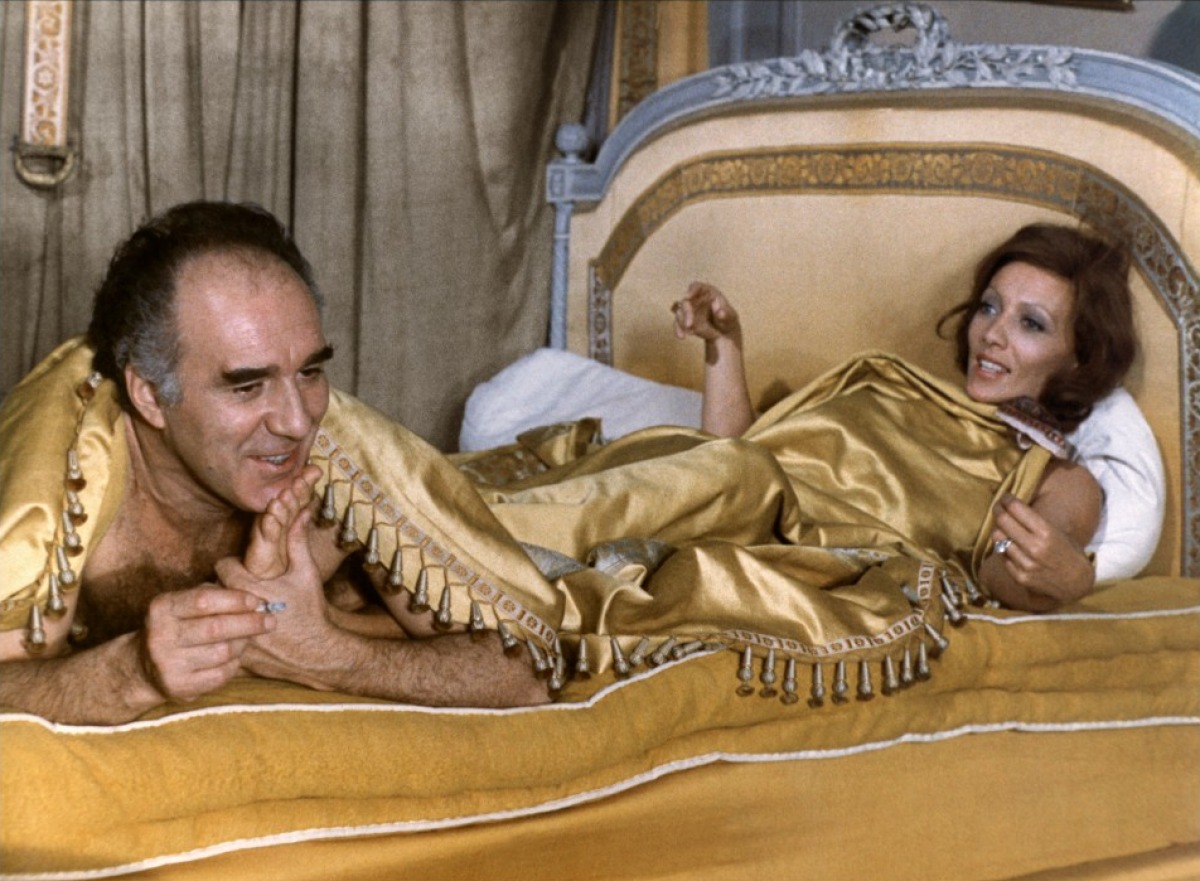
Michel Piccoli and Stéphane Audran in Les Noces Rouges.
This is the eighth screening in Matchbox Cineclub’s monthly series at The Old Hairdressers, which takes place on the third Thursday of every month. Previous screenings there have been The Beaver Trilogy (dir. Trent Harris, 2001; 1979-85), Stunt Rock (dir. Brian Trenchard-Smith, 1980) in association with Glasgow Film Festival, Who Are You, Polly Maggoo? (William Klein, 1966), Cecil B Demented (John Waters, 2000), Dünyayı Kurtaran Adam (Çetin Inanç, 1982), Me And You And Everyone We Know (Miranda July, 2005) and The Adventures of Buckaroo Banzai Across the 8th Dimension (WD Richter, 1984).
Our July screening at The Old Hairdressers will be WD Richter’s The Adventures of Buckaroo Banzai Across the 8th Dimension(1984), an inter-dimensional sci-fi-action-adventure-rock-n-roll-comedy-romance – pretty much the ultimate 1980s cult film. The screening takes place at 7pm on Thursday 16/07, upstairs in the gallery area of the bar.
The Adventures of Buckaroo Banzai Across the 8th Dimension (1984) stars Peter Weller as Buckaroo Banzai, a physicist-neurosurgeon-martial arts master-secret agent-test pilot-rock star. With The Hong Kong Cavaliers, a motley crue of scientists, engineers and special agents (including Clancy Brown and Jeff Goldblum) who double as his backing band, Buckaroo must battle to save the world from the alien Red Lectroids (led by Christopher Lloyd) and his human nemesis, the brain-fried Dr Lizardo (John Lithgow). Directed by WD Richter (writer of the 1978 Invasion of the Body Snatchers and John Carpenter’s Big Trouble In Little China), Buckaroo Banzai is utterly unique, endlessly quotable, ridiculously enjoyable and just one of our absolute favourites.
Buckaroo Banzai is the seventh screening in our monthly series at The Old Hairdressers, which takes place on the third Thursday of every month. Previous screenings there have been The Beaver Trilogy (dir. Trent Harris, 2001; 1979-85), Stunt Rock (dir. Brian Trenchard-Smith, 1980) in association with Glasgow Film Festival, Who Are You, Polly Maggoo? (dir. William Klein, 1966), Cecil B Demented (dir. John Waters, 2000), Dünyayı Kurtaran Adam (dir. Çetin Inanç,1982) and Me And You And Everyone We Know (dir. Miranda July, 2005).
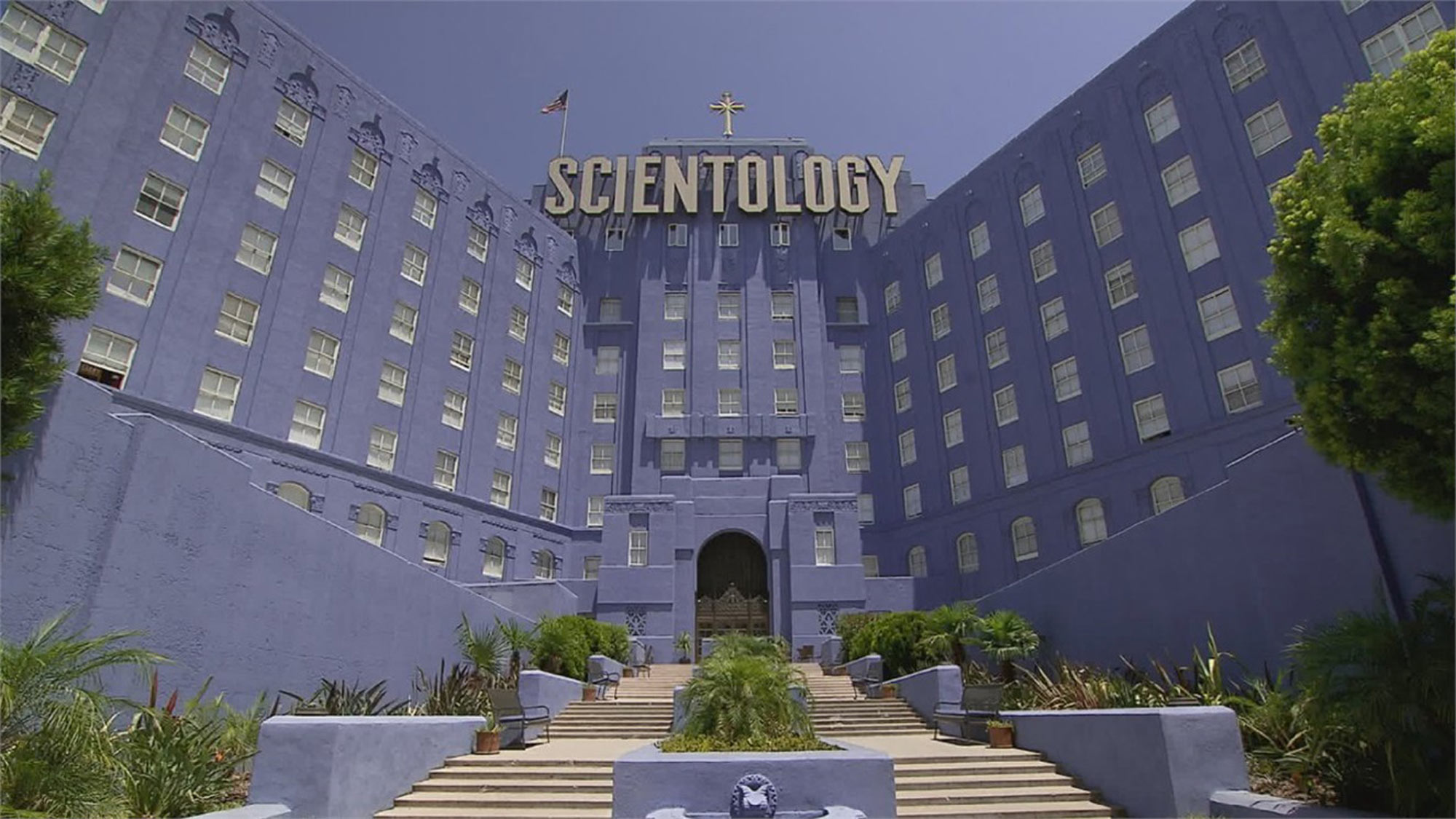
Going Clear (Dir. Alex Gibney, 2014) is screening at GFT until Thursday 2nd July. My accompanying programme note will be available at screenings – you can download the physical version here and there’s an online version at GFT’s blog here. GFT archives all its programme notes online here.
Some bonus material that didn’t make the final cut:
Scientology today list 13 bases in the UK, including the Hubbard Academy of Personal Independence Scientology Edinburgh.
Scientology ministers were authorised to perform wedding ceremonies by the Scottish registrar general in 2007. In 2013, the UK Supreme Court then ruled that a London Church of Scientology chapel was a “place of meeting for religious worship” and that henceforth could be used for marriages, creating uncertainty as to the future legal (particularly tax) status of Scientology in the UK.
At more or less the same time as the Granada documentaries on Scientology (footage, on YouTube here and here, featured in Going Clear), and the publication, in Britain, of Paulette Cooper’s exposé, The Scandal of Scientology, author Neil Gaiman was refused entry to his local prep school because of his family’s association with the religion (his father was a spokesperson). In August 1968, Gaiman was interviewed for BBC Radio’s World at Weekend, when the 7-year-old explained to Keith Graves that Scientology is ‘an applied philosophy dealing with the study of knowledge.’
World Gone Wild (dir Lee H Katzin, 1988), a post-apocalyptic B-movie, stars Adam Ant as Derek Abernathy, a murderous cult leader who preaches from a book entitled The Wit and Wisdom of Charles Manson. That book was retitled, in fact, after lawyers for Scientology got wind of the original choice – L Ron Hubbard’s Dianetics – and paid a visit to the producers (‘We have no idea how they heard about those scenes,’ a representative was quoted at the time).
Louis Theroux is also planning his first theatrical documentary, Stairway To Heaven, about Scientology, whose lawyers promptly informed Theroux that the church, not coincidentally, was producing one on him.
If you have any thoughts on Going Clear or my note, I’d love to hear them – post a comment here or on GFT’s blog (or you can even email me here).
1. Slow West‘s Scottish first-time director, John Maclean, cut his teeth making music videos for The Beta Band, for whom he played keyboards, samplers and decks. Forming in St Andrews, they famously benefited from the endorsement of John Cusack’s record store owner in High Fidelity (dir Stephen Frears, 2000) before splitting in 2004. Maclean made the most of tiny to non-existent budgets to make their memorably inventive promos, including Assessment (2004, with Robin Jones), which had waves of warriors from the beginning of time to the present day charging along one long length of beach in a single tracking shot (and was later ripped off by Romain Gavras for a Samsung advert).
2. Maclean’s little-seen first collaboration with Slow West star Michael Fassbender was Man on a Motorcycle (2009). Having met Fassbender through a mutual friend, Maclean’s music videos impressed the actor enough for him to offer just one day of work. Maclean maximised the brief window of opportunity by writing a script around a helmet-clad character, meaning he only needed to use Fassbender whenever the helmet came off, and a courier pal otherwise. Maclean shot Man on a Motorcycle entirely on a mobile phone, since he knew what it could and couldn’t do, and because he wouldn’t need to work with a crew.
3. Maclean’s next collaboration with Fassbender and his first ‘proper’ short, Pitch Black Heist, was just as inventive. The 14-minute short is built around a three-minute sequence of total darkness. Also starring Davos Seaworth Liam Cunningham, the story’s conceit is a light-activated alarm system requiring a couple of safe-breakers to prepare so that they can essentially do the job with their eyes closed. Maclean’s crew, a novelty in itself at that point, included Slow West cinematographer Robbie Ryan.
Review [spoiler free]
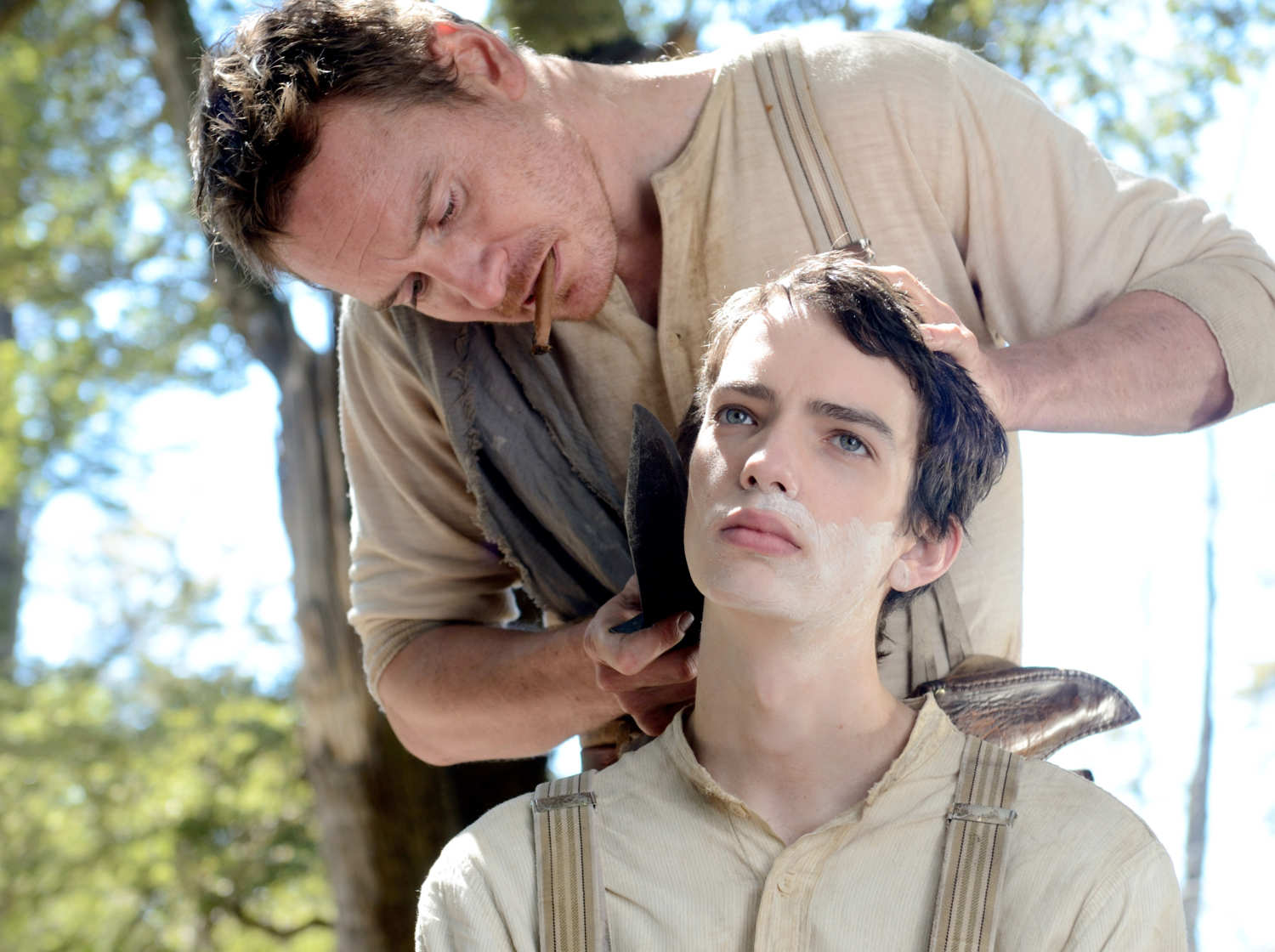
1. Set in 1870, Slow West tells the story of Jay (a perfectly cast Kodi Smit-McPhee), who travels “from the cold shoulder of Scotland to the baking heart of America,” aided by “brute” and “lonely, lonely man” Silas (Michael Fassbender). Jay, noble by birth, is on the lonely trail of his lost love, Rose (Caren Pistorius) who has fled their homeland with her father in as-yet-unexplained circumstances. It’s beautifully shot, by Robbie Ryan, on location in Wester Ross and an almost psychedelically vibrant New Zealand doubling for the US. Stripling Smit-McPhee (probably best known as the kid in The Road), pretty much nails his Scottish accent and generally conjours a spot-on David Balfour (on casting the Australian in a Scottish role, Maclean has explained, “I did look in Scotland a bit, but it’s actually tough to find 18 year olds that haven’t been to the gym.”) Ben Mendelsohn is effortlessly, casually malevolent in an extended cameo as bounty hunter Payne, while the South African-born Pistorius nails her small but pivotal role.
2. At a tight, concise 90 minutes, there’s no fat on Slow West at all. There’s a real, wicked humour to it and while it’s far too movie-movie to work as a historical drama, it’s wittier than it is laugh-out-loud funny. It’s fable-like, a kind of morality tale, but also constructed like a campfire tale, or a dark bedtime story. It’s anti-romantic, in a sense, so if it’s a fairy tale (and it does begin, “Once upon a time…”), it’s more like an original, Grimm-style one, where the kids all get eaten for being daft. Maclean’s careful visual construction allows for a series of subtle visual jokes that bring a tingle of excitement to even the bleakest moments (in particular, there’s a visual pun par excellence during the climactic gunfight). Maclean’s measured approach means these moments are peppered just carefully enough to keep you in the film, and still wrapped up in the travails of his characters.
3. The writing (also Maclean) and the performances are perfectly judged. Maclean has said the lead role was originally written for Fassbender, and it only became apparent as the writing progressed that he’d be too old (“I had to go round to Michael’s and say, ‘By the way, you’re not the lead any more.'” Maclean said, during a recent BAFTA Q&A in Glasgow). That Maclean ultimately wrote to Fassbender’s strengths (not least allowing him to use something close to his own accent), but also almost wrote him out, says something for the director’s integrity. And Slow West is everything a debut film should be – ambitious but not over-reaching, tightly scripted but not bare and parsed out so as to get the absolute most out the available resources. The film unfurls confidently but not audaciously and there’s a real, thrilling sense of a new, noteworthy filmmaker getting to grips with their one-ton pencil.
Silas (Michael Fassbender) and Jay (Kodi Smit-McPhee)
Post-mortem [spoilers]
1. The biggest spoiler (there’s that warning again) is the death of lead character Jay, shot accidentally by his “lost love” Rose as she defends her homestead against the bounty hunters he’s brought to her doorstep. It’s bold storytelling in some ways, though in retrospect completely inevitable. Of course, the exact circumstances of his end are prefigured very near the start, in a flashback to Scotland, and in another slightly later on. A little later, Silas and Jay stumble upon the skeleton of a man, still trapped under the tree he felled on top of himself. “That’s just a shame,” says Jay. “Is it?” says Silas, grinning. “No,” Jay smiles back. “No, it’s not. Charles Darwin talks of evolution by natural selection.” Silas concludes, “For our sake, let’s hope he’s wrong.” It registers as a humourous interlude on first viewing, but on reflection, it seems clear Rose’s bullet is the tree Jay brings down upon himself. Finally, around 2/3 of the way through, in a premonitory dream, Jay sees Silas and Rose shacked up with a baby, his namesake, and he himself nowhere to be seen. It couldn’t be clearer Jay’s not going to make it, but Maclean’s sleight of hand keeps the inevitable from seeming set. Jay and Silas are opposed in some senses, but I think it’d be a mistake to see Jay’s death as a vindication of pragmatism or pessimism, or droll punishment for his naiveté and sense of entitlement. He has an absurd death, just as his quest is absurd.
2. Having said that, at the BAFTA Q&A, Maclean discussed the humour of the film, with particularly reference to the man found crushed by the tree. “I had a backstory for that guy. He came all the way from Scotland. He survived the boat, which, like, 20% of people survive, and then he survived travelling all the way to that point and then he started building a house and got crushed by a tree.” Maclean explained, “I think a film like Fargo, which I really love for tone, would be a touchstone for this film, which is never ever doing jokes but doing tragic situations that happen to be ridiculous.” That could be the next film, he joked, “Slow West 2: The Life of the Tree Man.”
3. Speaking of the length of the film, particularly the relatively brisk ending, Maclean was adamant it was all deliberate. “Somebody said to me, ‘the ending was really abrupt,’ but when you watch a lot of ’50s noir cinema, which I love, the ending is, like, so quick. It’s kind of basically the baddie gets shot, there’s a kiss and then it ends, and the credits, and it’s all in 10 seconds. I do really love that. I hate the long, drawn-out endings… I definitely knew that I wanted to make a shorter film.” Some of the bigger cinemas, said Maclean, “Aren’t taking it cos it’s got ‘Slow’ in the title.” That’s certainly a shame, because it deserves to be seen, and especially on the big screen. Luckily, Slow West is still getting a decent release, from this Friday, in arthouse cinemas like GFT and the director’s old place of work, Edinburgh’s Cameo. What’s next for Maclean? “I’m starting to write again,” he told the BAFTA audience, “so I’m thinking something contemporary and something maybe in the noir-thriller-heist – the other genre I love – but it’s really early days.”
What does VHS mean to you? Three quite different but uniformly excellent documentaries at Edinburgh International Film Festival – Remake, Remix, Rip-off (Cem Kaya, 2014), Chuck Norris Vs Communism (Ilinca Calugareanu, 2015) and Stand by for Tape Back-Up (Ross Sutherland, 2015) – illustrate the unique appeal and value of VHS. Your answer to the question will of course be much different, depending on when and where you were born. To me, VHS means black market video nasties on sale in Ayr Indoor Market, hardware stores renting 15s to 10 year-olds because “our mum said it was OK” and racing home after school, day after day, to watch 30mins of a borrowed copy of the forbidden Pulp Fiction while the house was still empty.
Chuck Norris vs Communism (dir Ilinca Calugareanu, 2015)
Such illicit thrills were literal child’s play compared to life in Nicolae Ceaușescu’s Romania, as recounted in Chuck Norris Vs Communism. In 1985, the communist regime was in its 20th year, censorship and state surveillance were reaching a peak and the country was effectively shut off from western culture. With only two hours of approved television a day, there was a huge, as yet un-tapped market for western entertainment. Smuggled VHS tapes became enormously popular – facilitated by one enterprising man, Zamfir, who recruited a courageous state translator, Irina Margareta Nistor, to dub translation over the top of the films. For a generation, for an entire nation, her voice became the second most familiar, after Ceaușescu’s. Ilinca Calugareanu’s film makes a persuasive, not to say heart-warming case for the power of these films on VHS. “It’s because they were deemed trivial,” explains Zamfir, “that they had such a big impact.”
Those raised before the internet made everything so gloriously available at the click of a mouse may also recall how revolutionary VHS was in simply making films widely available and accessible to their original audience. Cem Kaya’s unexpectedly affecting documentary, Remake, Remix, Rip-off, tells the story of a vital period in Turkish cinema history, one which could have been all but wiped from history were it not for a secondary market on VHS in Germany. With very limited resources, only three writers and no copyright law, the Turkish film industry made the very best of what it had, producing countless hundreds of films that would later gain notoriety as Turkish Star Wars, Turkish Superman, Turkish Godfather, etc, etc. Kaya’s doc goes a long way to restoring dignity to the filmmakers whose talent was compromised and legacy almost obliterated by government censorship.
Stand by for Tape Back-Up (dir Ross Sutherland, 2015)
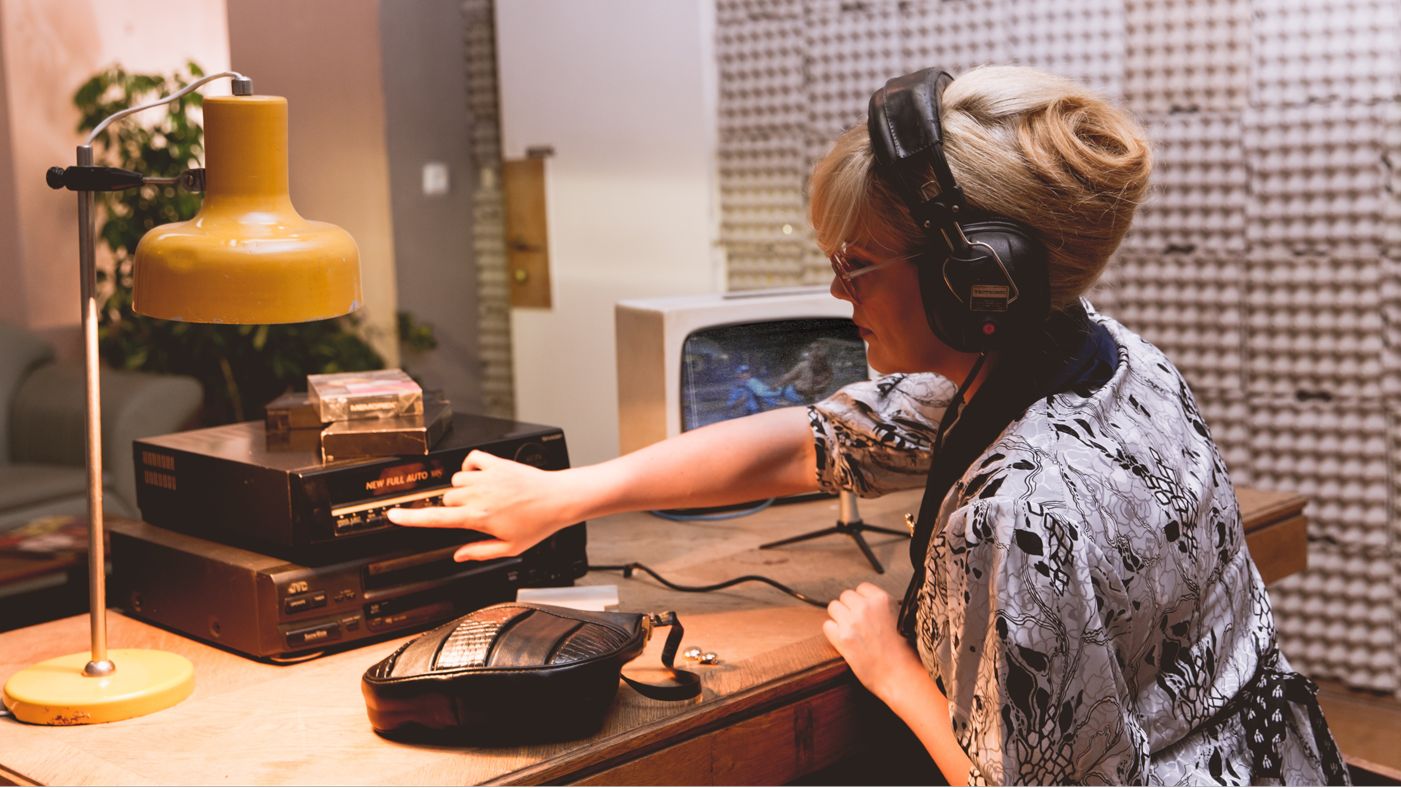
When I think of VHS, I also think of breaking plastic tabs to protect films recorded from TV, sellotaping over plastic tabs to record again and again over films recorded from TV. Part of the continuing charm of VHS is that it has characteristics that can only be replicated, simulated by superior technology, technology that struggles to emulate VHS’s almost accidental properties. Ross Sutherland’s film, Stand by for Tape Back-Up, deriving from a live show he performed at the Fringe in 2014, spins a wonderfully effective, autobiographical piece of art from these properties. Almost all of Sutherland’s film is derived from a videocassette he inherited from his grandfather, upon which they both would record, “slamming it in the machine” and pressing record, “no respect for the start and end of programmes.” Sutherland narrates, playing, pausing, rewinding, looping back and forth and extracting and projecting poetry on to the jittery images. Hiding on this tape, Sutherland compelling and movingly illustrates, is his whole life story. As one of Chuck Norris Vs Communism’s talking heads coincidentally explains, “There was a whole life in the video player.”
EIFF 2015 runs from 17th-28th June. Read my picks of the documentaries here, my picks of the old films screening again at EIFF 2015 here and my picks of the features here. Check out EIFF’s 2015 brochure here.




 Physical Impossibility