In the basement of the Harvard Medical School, Dr Edward Jessup floats naked in total darkness. The most terrifying experiment in the history of science is out of control and the subject is himself! Ken Russell’s cult classic was originally released in Warner Brothers’ Megasound format, a “revolutionary new concept in the sensation of sound”, designed to enhance the visceral viewing experience, delivering low-frequency thrills at high volume. Now, Altered States is presented for the first time in Matchbox Cineclub’s own Immers-o-sound™ system, developed exclusively for this screening in association with Glasgow Film Festival. Immerse yourself in terror!
The screening, which will be preceded by Matchbox’s 30-minute FREAK-SUITE edit, takes place Thursday 18/02 from 7pm in the gallery area of The Old Hairdressers, Glasgow.
Tickets are £5 from the GFF website – on sale from 10am on Monday 25th January.
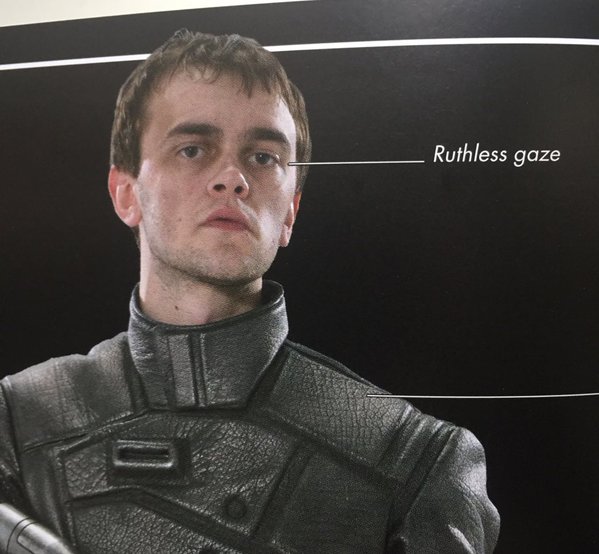
Bala-Tik (Brian Vernel), from Star Wars: The Force Awakens: The Visual Dictionary
Never mind the [REDACTED] of [REDACTED] or the grinning, winning strides for representation – for many Scottish film-goers, the surprise of Star Wars: The Force Awakens was the sudden interjection of a distinctly Glaswegian voice. That voice belongs to Bala-Tik, a representative of the Guavian Death Gang intent on settling a score with swaggering swindler Han Solo. According to the official Star Wars website, Bala-Tik’s “black leather coat and percussive cannon indicate his status within the galactic underworld” and he seems pretty confident bellowing reproachfully at our hero. “Han So-lo,” he says with a wee shake of his head, “You’re a dead man.”
Alongside Solo, Bala-Tik shares this debut scene with Chewbacca, some anonymous Guavian cohorts, everyone’s favourite non-threatening newcomer, BB-8, and a couple stars of The Raid playing members of the opposing Kanjiklubgang. Yayan Ruhian’s dialogue as Kanjiklub leader Tasu Leech is subtitled, but as yet I’ve been unable to confirm whether or not he’s speaking his native Indonesian – only that his character “refuses to speak a word of Basic*, deeming it a soft language for soft people, though he can understand it well enough”. Bala-Tik, on the other hand, doesn’t require subtitles because, like most movie Scots – thank the maker – he’s easier to understand than your average Wookiee. “We loaned you fif-ty thou-sand for this job,” he levels, “I heard you also borr-owed fif-ty thou-sand from Kanji-klub.” Every uttered word, unusually to Glaswegian ears at least, is distinct and equally weighted.
“Enunciate, darling. Eh-nu-hun-ci-ate.”
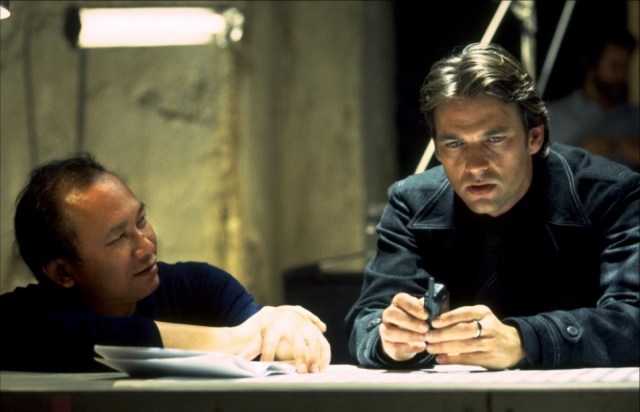
The accent is broad and unmistakeable, sure – it belongs to Brian Vernel**, a 24-year-old Glaswegian graduate of the former RSAMD (now the Royal Conservatoire of Scotland) living many a young person’s dream right now – but it certainly seems dressed up for international audiences. Vernel joins a long line of over-enunciating Scots in Hollywood films, from Dougray Scott in Mission Impossible 2 (“You are going to give me lots of mon-nay”) to Kate Dickie in Prometheus. Emma Thomson’s drawn out, sing-song Glaswegian in The Legend of Barney Thompson last year was a decent replica of the familiar movie version, if, like that of many genuine Scots on screen, it was a little too crisp and slowed to ring true.
It’s almost certainly not Vernel’s fault – the actor has been picking up plaudits since he was a student playing Macbeth on stage, or appearing in the Citizens’ Theatre’s 2013 adaptation of Takin’ Over The Asylum (see trailer above) – and it definitely could be worse. Gregory’s Girl was actually wholly redubbed for its American release and Trainspotting‘s opening scenes were similarly submitted to a “slowing down” by American distributors Miramax.
So Vernel hopefully has a glittering career ahead of him, especially given he’s proved he can adapt for those lazy American ears. As for Bala-Tik – spoiler – he survives a subsequent Rathtar attack intact and ultimately enjoys more dialogue than R2D2 and C3PO combined. If a dedicated spin-off might be far-fetched, the door is certainly open for a return in Episodes VIII or IX. Tell that tae Kanjiklub!
Sean Welsh
Ragin’
* [Galactic] Basic is Star Wars’ name for English, or French, or Spanish – whatever the Earth translation you’re watching, wherever you are.
** You may have seen Vernel in BBC’s recent Bernard Cornwell adaptation The Last Kingdom, or in their adaptation of JK Rowling’s The Casual Vacancy.
I saw a gazillion brand-new films in 2015, and discovered or revisited a gazillion older films too. I enjoyed slogging through submissions for Glasgow Film Festival, previewed the festival for their blog, then saw many more films during the festival itself. Later in the year, I rocketed back-and-forth to Edinburgh International Film Festival, ripping and tearing through their press screenings, special events and videotheque.
Through the year, I wrote a handful of programme notes for GFT’s new releases, sat on the submissions panel for the Document International Human Rights Film Festival for the first time, programmed a year’s worth of Matchbox Cineclub screenings and blew the money I might have saved through torrenting on yet more DVDs, Blu-Ray and downloads. I even subtitled a few new releases on their Sky Box Office debut for my day job. And yet, of course, I missed so, so many films. For every shitty American Ultra, Blackhat, Everest, Fantastic Four, Jupiter Ascending, Terminator Genisys, The Man From UNCLE or Tomorrowland I threw my figurative shoes at, it seemed there were six much more promising films that passed me by.
But then that’s fine because this was, on reflection, a pretty fucking good year for movies overall. Here are my favourites – selected not on sheer enjoyment or on academic worthiness alone, but simply on how strongly I’d recommend them – followed by some chat about the top five:
Star Wars: The Force Awakens (JJ Abrams)
Mad Max: Fury Road(George Miller)
Slow West (John Maclean)
Tangerine (Sean S Baker)
It Follows (David Robert Mitchell)
A Pigeon Sat On A Branch Contemplating Existence (Roy Andersson)
The Lobster (Yorgos Lanthimos)
L’il Quinquin (Bruno Dumont)
There Are Monsters (Jay Dahl)
Remake, Remix, Rip-Off (Cem Kaya)
Also Awesome:9999, Bitter Lake, Call Me Lucky, Carol, Catch Me Daddy, Chuck Norris vs Communism, Dope, Electric Boogaloo: The Wild, Untold Story of Cannon Films, Force Majeure, Fear Itself, Future Shock: The Story of 2000 AD, Girlhood, Going Clear, Inside Out, Koza, The Martian, Mission Impossible: Rogue Nation, Something Better To Come, Stand By For Tape Back-Up, Straight Outta Compton, Tale of Tales, Turbo Kid and Wyrmwood: Road of the Dead.
Star Wars: The Force Awakens. Occasionally ropey CGI. Unoriginal plot. No resolution. These are fair criticisms of JJ Abrams’ joyous, unstoppable, gloriously critic-proof magic trick. If we ignore the mealy-mouthed, misogynist smart-arses rationalising their discomfort with the main character’s presumed lack of a penis, you’re mostly left looking at what happens when 30 years of fanboys’ how-I-would-do-its evaporate before their eyes. For my money, Abrams’ effort is simply great fucking fun from start to finish, and his and Kasdan’s choices – the very deliberate parallels with A New Hope in particular – actually make perfect sense, if you feel compelled to pull them apart. It’s meta for the first time – The Force Awakens has as much as of Lucas’ original trilogy in its DNA as it does Flash Gordon serials or The Hidden Fortress – but its real strength is how expertly it balances its homage with innovation. Abrams reconfigured Star Wars for the 21st Century almost perfectly, so you can imagine 2035’s special edition is going to be incredible.
Mad Max: Fury Road. A beautiful, thrilling thing, this film. Its incredible trailer promised the world, so it’s kind of miraculous that Miller delivered, and that actually no trailer could spoil or really oversell it. Contrast Fury Road to The Force Awakens, the details of which Abrams and Disney had to guard incredibly carefully to preserve the virgin viewing experience. Plot details couldn’t spoil Fury Road, simply because its all in the experience – pure cinema – and it’ll work the same way again and again and again.
Slow West. I loved it when I first saw it, and John Maclean’s confident debut ultimately held its ground against an unusually strong slate of films this year. Small but perfectly-formed – basically a wee gem. Check out my original review here.
Tangerine.Another beautifully self-contained film that arrived on a small wave of hype, mostly based on it having been entirely filmed on an iPhone 5.It lived up to the hype, but the twist was the gimmick was practically invisible. Baker’s film is built on spectacular performances, sparkling with energy, intimacy and pathos, but it looks gorgeous too.
It Follows. It’s funny, this flick played a lot of people, myself included, like fiddles but it left a lot of other people cold. I loved it intellectually, for the mythology it teased, for the aesthetic and the small auteurish details (like the little weird handheld, clamshell device) that clash conspicuously with the generally throwback mise-en-scene. But it also conjured a squirmingly visceral terror in me that’s difficult to relate and certainly impossible to persuade the unaffected to feel. For a critic, that’s frustrating but for a battle-hardened horror fan it was just delightful.
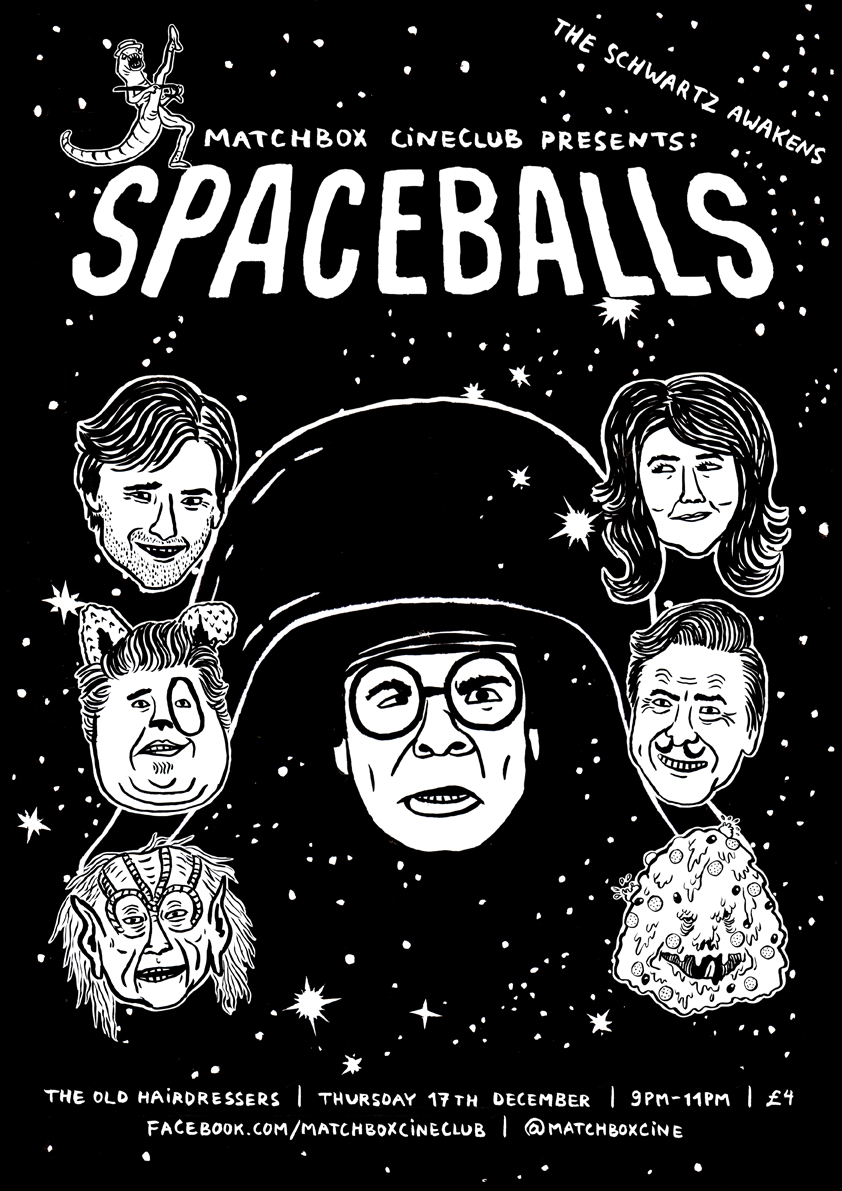
Love Star Wars? Missed out on tickets for The Force Awakens on opening night? Or maybe you HATE Star Wars? Want to escape the onslaught? We’re excited to announce that Matchbox’s final screening of 2015, on the very day Episode VII arrives, will be Spaceballs (Mel Brooks, 1987).
Comedy legend Mel Brooks leads an all-star cast including John Candy, Rick Moranis and Bill Pullman in the original Star Wars spoof. Our Spaceballs screening takes place on Thursday 17/12, at The Old Hairdressers, Glasgow.
Matchbox Cineclub #12: Spaceballs poster by Valpuri Karinen
When the evil Dark Helmet (Rick Moranis) attempts to steal all the air from planet Druidia, a determined Druish Princess (Daphne Zuniga), a clueless rogue (Bill Pullman) and a half-man/half-dog creature who’s his own best friend (John Candy) set out to stop him. But with the forces of darkness closing in on them at ludicrous speed, they’ll need the help of a wise imp named Yogurt (Mel Brooks) and the mystical power of “The Schwartz” to bring peace and merchandising rights to the entire galaxy!
Frederick Wiseman in conversation with MOMI chief curator David Schwartz.
Last week, I was lucky enough to attend An Evening with Frederick Wiseman at New York’s Museum of the Moving Image, hosted by MOMI’s chief curator, David Schwartz. Over a couple hours, the fleet and sharp-witted 85-year-old held forth on his practice and experience, focussing, in line with MOMI’s current season, on his New York-focussed films. In the process, he elucidated the deceptively benign assertion that seems to have driven his 40-film and almost 50-year career – that “human behaviour is strange and fascinating.”
Wiseman presented and discussed clips from five of his New York-focussed films, Hospital (1969), Welfare (1975), Model (1980), Central Park (1989) and his latest, In Jackson Heights (2015), although early on he made clear this geographical theme in his work was purely happenstance. The discussion, therefore, encompassed his entire career, even briefly touching upon his decision at 30 to abandon a career in law to explore filmmaking. Some of the more salacious gems gleaned in the two or so hours at MOMI:
Wiseman declined a request to send Stanley Kubrick a complimentary print of one of his films, making him pay to rent it. Later he found Kubrick had cribbed the first half of Full Metal Jacket (1987) “shot for shot” from his Basic Training (1971).
Wiseman then drily drew the audience’s attention to the similarities between Arthur Hiller’s drama The Hospital (1971), which won an Oscar for writer Paddy Chayefsky, and Wiseman’s own Hospital (1970).
He quipped dismissively that Errol Morris’ description of him as “the undisputed king of misanthropic cinema” (from a Paris Review article reprinted in MOMI’s hand-out) was “classic projection”.
This slideshow requires JavaScript.
A question from the audience, however, drew perhaps the most interesting response of the evening. Wiseman was asked if, in his 40 year-career, he’d found his camera affected the behaviour of those he pointed it at. He described an instructive event from the filming of his 1969 documentary Law And Order, where cops were forced to chase a prostitute they’d been attempting to shake down. While the cameras rolled, one of the cops began to strangle the woman, though he eventually let her go. Would the woman have been killed but for the presence of Wiseman and his small crew? No, the director thought not, since he saw that the cop only intended to punish the woman for daring to buck the standard shakedown protocol. That he allowed the cameras to capture the moment was because, to him – to them – the action was perfectly acceptable, even mundane. “We all,” Wiseman concluded, “think our behaviour is normal.”





 Physical Impossibility